Giant isopod
Scientific name: Bathynomus giganteus
The Giant isopod is a sea creature that lives near the seafloor at depths of about 170–2,140 m, growing to about 50 cm. In Abyss Dive you meet it at 880 m, in the Twilight Zone (Mesopelagic).
- Depth range
- about 170–2,140 m
- Max size
- about 50 cm
- Zone in this guide
- Twilight Zone 200–1,000 m
- Bioluminescence
- No
- Habitat
- Near the seafloor
- Depth in the 3D dive
- 880 m
What is it?
A relative of the pill bug that grows tens of centimeters long, a scavenger of the deep. It feeds on the carcasses of whales and fish that sink to the seafloor.
Did you know?
One at an aquarium in Toba, Japan, last ate in January 2009 and went more than five years without food before dying in 2014.
What it looks like
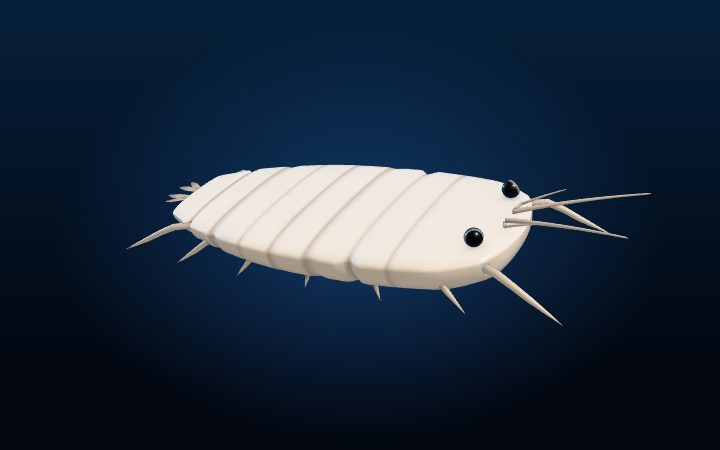
Armor of overlapping pale brownish-gray segments covering a flat oval body, two pairs of short antennae, seven pairs of legs, large compound eyes, and a fan-shaped plate at the tail
More about this creature
Where and how deep it lives
Bathynomus giganteus lives on cold, deep seafloors in the western Atlantic, including the Gulf of Mexico and the Caribbean. It has been recorded at about 310–2,140 m, and more than 80% of individuals are found between about 365 and 730 m. In Exuma Sound in the Bahamas it was common in water of about 3.25–13 °C, and most abundant at the colder end.
Food and hunting
It is mainly a scavenger of dead whales, fish and squid, but may also catch slow-moving animals. A study of 1,651 giant isopods found fish in their guts most often, followed by cephalopods and decapod crustaceans. By eating carcasses that sink to the seafloor, it helps recycle nutrients in the deep sea.
Body and adaptations
Its body is divided into head, thorax and abdomen. It is typically about 19–36 cm long, and the largest confirmed specimen was about 50 cm (a 76 cm report in the popular press is unverified). It has seven pairs of walking legs on the thorax, and five pairs of abdominal appendages that serve as both swimming legs and gills.
Unusually for a deep-sea animal, it has large, well-developed compound eyes with nearly 4,000 facets. A reflective layer behind them makes the eyes seem to glow in a light. When threatened it rolls into a ball like a pill bug, exposing only its armored back. Its size is usually explained as deep-sea gigantism, the tendency of cold-water deep-sea invertebrates to grow larger.
Life cycle and behaviour
Females carry their eggs in a brood pouch under the body, and the young hatch as miniature adults called mancas, skipping a larval stage. Mancas lack the seventh pair of legs and can reach about 6 cm. Females carry roughly as many eggs as smaller isopods, but each egg is larger in proportion to the mother's size.
As of 2021, only two egg-carrying females had ever been documented across the whole genus, so breeding is rarely seen. Lifespan is estimated at about 7.7 years for females and 6 years for males.
Humans and conservation
Alphonse Milne-Edwards described the species in 1879 from a young male caught in fishermen's nets off the Dry Tortugas in the Gulf of Mexico; it was the first Bathynomus species known to science. No female was collected until 1891.
It isn't fished commercially, but giant isopods are caught in large numbers as bycatch in deep-water fisheries, and an estimated 50–100% of those thrown back die. Some seaside restaurants in northern Taiwan boil related species and serve them, and many public aquariums keep them.
Sources & further reading
- Bathynomus giganteus — Wikipedia en.wikipedia.org
- Giant isopod dies after five-year 'hunger strike' — Practical Fishkeeping www.practicalfishkeeping.co.uk
- Bathynomus — Wikipedia en.wikipedia.org