Giant siphonophore
Scientific name: Praya dubia
The Giant siphonophore is a bioluminescent (light-making) sea creature that lives in open water at depths of about 700–1,000 m, growing to about 40 m. In Abyss Dive you meet it at 790 m, in the Twilight Zone (Mesopelagic).
- Depth range
- about 700–1,000 m
- Max size
- about 40 m
- Zone in this guide
- Twilight Zone 200–1,000 m
- Bioluminescence
- Yes
- Habitat
- Open water (swimming)
- Depth in the 3D dive
- 790 m
What is it?
One of the longest animals on Earth, sometimes over 40 m. It looks like a single animal, but it's a colony of many individuals (zooids) strung together, each specializing in swimming, hunting or digestion.
Did you know?
It hangs a curtain of stinging tentacles to catch prey, and lures it in with blue bioluminescence.
What it looks like
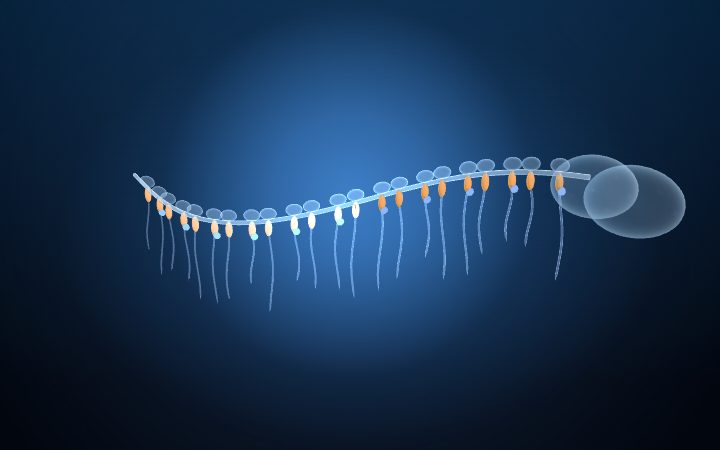
A pair of transparent bell-shaped swimming organs at the front, followed by an endless thin stem strung with small individuals like beads and a curtain of tentacles, glowing blue
More about this creature
Where and how deep it lives
Praya dubia has been recorded from Iceland in the North Atlantic to Chile in the South Pacific, living mostly at about 700–1,000 m.
Food and hunting
Where food is plentiful, it holds its position and spreads its tentacles, whose stinging cells paralyze or kill whatever they touch. It feeds mainly on gelatinous animals and small crustaceans and may also take small fish and fish larvae.
Body and adaptations
At the front of the colony are two swimming bells (nectophores) that pulse in rhythm to pull the whole colony along. Behind them trails a thin stem about as thick as a broomstick, with the same cluster of specialized zooids repeated over and over along its length.
Each cluster includes long tentacles for catching prey, feeding zooids that act as mouth and stomach, zooids that may help with defense, and transparent bracts that shield the others when the colony is disturbed. The colony is usually whitish and transparent. Reported maximum lengths vary between sources, from more than 40 m to about 50 m.
Humans and conservation
Quoy and Gaimard described the species in 1827. Specimens hauled up in nets were reduced to shapeless jelly, so for a long time no one recognized them as a single kind of animal. Its true length became clear only after MBARI observed living colonies during a systematic survey of the Monterey Bay water column in 1987, and it later appeared in the second episode of the BBC's Blue Planet II.
Sources & further reading
- Praya dubia — Wikipedia en.wikipedia.org
- Praya — The Bioluminescence Web Page, UC Santa Barbara biolum.eemb.ucsb.edu