Lovely hatchetfish
Scientific name: Argyropelecus aculeatus
The Lovely hatchetfish is a bioluminescent (light-making) sea creature that lives in open water at depths of about 100–2,060 m, growing to about 8 cm. In Abyss Dive you meet it at 400 m, in the Twilight Zone (Mesopelagic).
- Depth range
- about 100–2,060 m
- Max size
- about 8 cm
- Zone in this guide
- Twilight Zone 200–1,000 m
- Bioluminescence
- Yes
- Habitat
- Open water (swimming)
- Depth in the 3D dive
- 400 m
What is it?
A small fish, flat like a hatchet blade and flashing silver when seen from the side. It stays at about 300–600 m by day and 100–300 m at night, using its big upward-looking eyes to spot the silhouettes of prey overhead.
Did you know?
Light organs along its belly match the dim light filtering down from above, erasing its shadow for predators looking up from below (counterillumination).
What it looks like
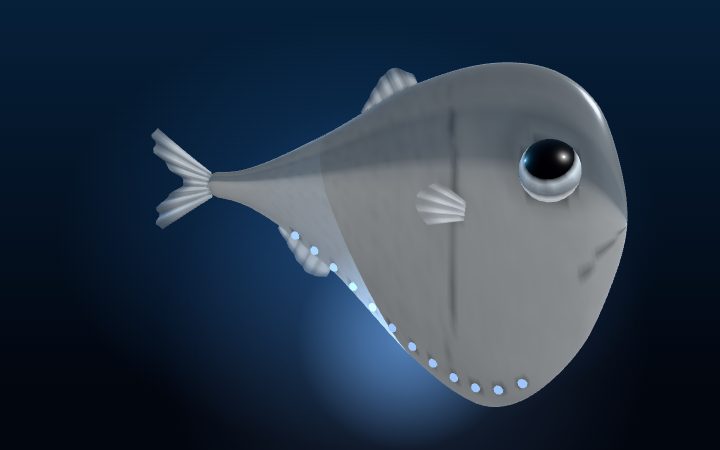
A tall, very thin, hatchet-blade-shaped silver body seen from the side, large tubular eyes facing upward, a row of blue light organs along the belly edge, and a slender tail stalk
More about this creature
Where and how deep it lives
It is widespread in tropical and temperate waters of the Atlantic, Indian and Pacific oceans. In the eastern Atlantic it ranges from Portugal to Senegal, in the western Atlantic it has been recorded between 40°N and 10°N and between 15°S and 35°S, and it has recently been reported from the Gulf of Aden and the Arabian Sea. Its overall depth range is about 100–2,056 m.
Food and hunting
It is a selective feeder that hunts at dusk, mainly on conchoecid ostracods, tiny crustaceans enclosed in a clam-like shell, with smaller amounts of copepods, decapod larvae and fish larvae. In the Gulf of Mexico, fish under 30 mm long fed mostly on ostracods and copepods, while larger ones switched to euphausiids, molluscs and fish.
Body and adaptations
It is a small fish, reaching about 8.3 cm standard length and about 21 g. The body is deep and extremely compressed from side to side, so the chest forms the 'blade' of the hatchet and the slender tail stalk its 'handle'. Its silvery scales are delicate and rub off easily.
Marine hatchetfishes have large, sometimes tubular eyes that gather very faint light, and the upward tilt is most pronounced in Argyropelecus. Its silvery colouring and bioluminescence work together to hide it in the dim light filtering down from above.
Life cycle and behaviour
Very little is known about its reproduction. Adult photophores begin to develop at a length of about 15 mm.
Humans and conservation
It was described by Valenciennes in 1850, and its fossil record runs from the Pliocene to the present. Despite the shared name, it is not closely related to the freshwater hatchetfishes kept in aquariums, which belong to a different order. It is of no interest to fisheries and is listed as Least Concern on the IUCN Red List (assessed 2014).
Sources & further reading
- Argyropelecus aculeatus — FishBase www.fishbase.se
- Marine hatchetfish — Wikipedia en.wikipedia.org
- Argyropelecus aculeatus — Wikipedia en.wikipedia.org