Northern basket star
Scientific name: Gorgonocephalus eucnemis
The Northern basket star is a sea creature that lives near the seafloor at depths of about 15–2,000 m, growing to about 14 cm. In Abyss Dive you meet it at 900 m, in the Twilight Zone (Mesopelagic).
- Depth range
- about 15–2,000 m
- Max size
- about 14 cm
- Zone in this guide
- Twilight Zone 200–1,000 m
- Bioluminescence
- No
- Habitat
- Near the seafloor
- Depth in the 3D dive
- 900 m
What is it?
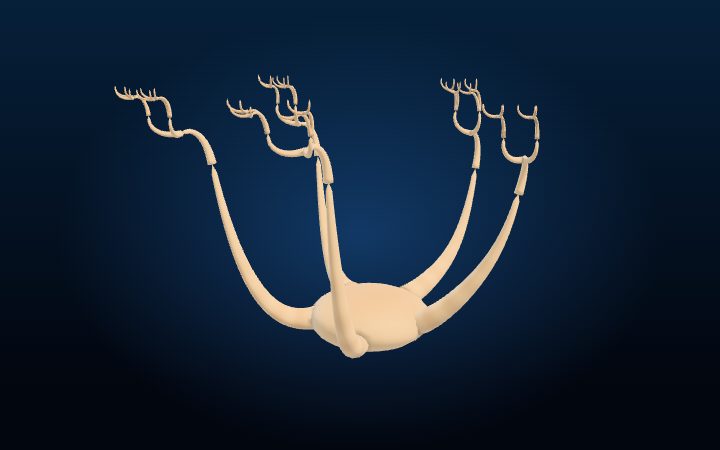
A relative of brittle stars whose five pairs of arms branch and branch again until they look like a shrub or a basket. It lives on rocky ground with strong currents and is most common in shallow water, but it has been found as deep as 2,000 m.
Did you know?
By day it hides under sponges or in crevices. At night it climbs up and spreads its branching arms like a net to catch food.
What it looks like
A disc-shaped body about 14 cm across with five pairs of arms that fork in two again and again toward the tips, curling like tendrils; pale orange to beige
More about this creature
Where and how deep it lives
This basket star circles the high latitudes of the Northern Hemisphere. It is recorded from the Arctic Ocean and the North Atlantic (south to the Faroe Islands and Massachusetts), the East Siberian and Chukchi seas, and the North Pacific from the Bering Sea to Japan and Laguna Beach, California. It is most common at about 15–150 m and, besides rock, also lives on mud and sand with protruding boulders and among sea pens and sea fans.
Food and hunting
It spreads its arms like a fan across the current to catch drifting northern krill, copepods, arrow worms, jellyfish and detritus. Tiny hooks and spines on the arms grip the prey, mucus immobilizes it, and the coiling branch tips pass it to the mouth on the underside of the disc.
Basket stars are known to catch prey up to about 3 cm long, and this species has also been reported eating a small seafloor sea pen, Stylatula elongata.
Body and adaptations
The central disc reaches about 14 cm across. Color ranges from white and beige to tan, orange-red and pink, and the disc is often darker than the arms. Beneath its tough, rubbery skin is a skeleton of calcified plates. It has no anus, so undigested food leaves through the mouth. With its branch tips curled into little loops and its arms constantly writhing, it looks like a moving shrub.
Life cycle and behaviour
The sexes are separate, and after spawning the larvae join the plankton and drift with the currents. In Puget Sound, juveniles have been found inside the throats of polyps of the soft coral Gersemia rubiformis, where they appear to grow and feed until their arms are long enough to catch food on their own.
Adults also tend to stay near Gersemia corals and sponges. Hiding in toxic sponges gives them some protection, though fish and crabs still eat them, and they return to the same spot again and again.
Humans and conservation
Johannes Müller and Franz Troschel described the species in 1842. The genus name Gorgonocephalus combines Greek words for 'dreadful' and 'head', after the Gorgon of myth, and eucnemis means 'good boot'. Public aquariums sometimes display it, but it is tricky to keep.
Sources & further reading
- Gorgonocephalus eucnemis — Wikipedia en.wikipedia.org
- Gorgonocephalus eucnemis — Invertebrates of the Salish Sea (Walla Walla University) inverts.wallawalla.edu