Venus' flower basket
Scientific name: Euplectella aspergillum
The Venus' flower basket is a sea creature that lives near the seafloor at depths of about 100–1,000 m, growing to about 30 cm. In Abyss Dive you meet it at 730 m, in the Twilight Zone (Mesopelagic).
- Depth range
- about 100–1,000 m
- Max size
- about 30 cm
- Zone in this guide
- Twilight Zone 200–1,000 m
- Bioluminescence
- No
- Habitat
- Near the seafloor
- Depth in the 3D dive
- 730 m
What is it?
A glass sponge that weaves an elegant lattice basket from glassy (silica) spicules. It mostly lives anchored to the bottom deeper than 500 m by a root tuft of hair-fine glass fibers.
Did you know?
A pair of shrimp that slip in as juveniles grow too big to leave and live out their lives together inside. In Japan it was given as a wedding gift, symbolizing 'growing old together and sharing one grave'.
What it looks like
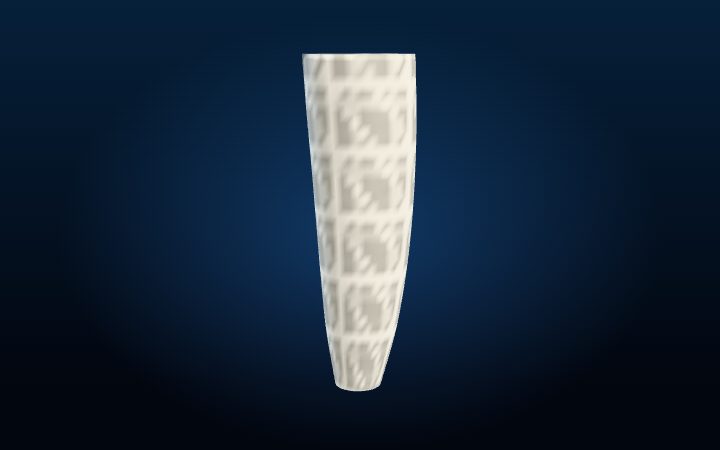
A slightly curved, cylindrical white lattice basket 10–30 cm tall with spiral ridges between the mesh, a sieve-like lid at the top, and a tuft of fine glass fibers at the base as roots
More about this creature
Where and how deep it lives
Venus' flower basket is best known from deep water around the Philippine Islands in the western Pacific, while other members of the genus live off Japan and in the Indian Ocean. It has been recorded at about 100–1,000 m and usually stands 10–30 cm tall.
Food and hunting
It is a filter feeder, drawing seawater through its body to capture plankton and marine snow, the drifting flakes of organic debris. In a 2021 study in Nature, Italian researchers used supercomputer flow simulations to show that the spiral ridges on the outside slow and swirl the water inside, keeping food particles and reproductive cells in the basket up to twice as long.
The same simulations showed that the porous lattice creates a zone of calm water around the sponge that pushes turbulence downstream. As a result it endures far less stress on the deep seafloor than a solid cylinder of the same size would.
Body and adaptations
The skeleton is built from six-rayed silica spicules whose three axes meet at right angles, and it also contains silica nanoparticles. The sponge extracts silicic acid from seawater to make its glass fibers; those that anchor it in the sediment are about 5–20 cm long and as thin as a human hair, and their anchor-shaped tips carry six teeth.
One comparison found that an aluminum tube of the same dimensions but uniform material would have only one-hundredth of the stiffness, which is why the structure is regarded as both light and remarkably rigid.
Life cycle and behaviour
Its reproduction is poorly known. Sperm found in one specimen suggests it is a hermaphrodite, and because it reproduces sexually, the swirling flow inside may help drifting sperm meet eggs. A pair of shrimp living inside the lattice feeds on particles the sponge collects and keeps the interior clean.
Humans and conservation
Richard Owen described the species in 1841 from a 200 mm specimen, and four subspecies are now recognized. Its lattice has inspired structural designs, including one with a higher strength-to-weight ratio than diagonally reinforced square grids.
Sources & further reading
- Venus' flower basket — Wikipedia en.wikipedia.org
- How intricate Venus's-flower-baskets manipulate the flow of seawater — Science News (2021) www.sciencenews.org