Firefly squid
Scientific name: Watasenia scintillans
The Firefly squid is a bioluminescent (light-making) sea creature that lives in open water at depths of about 20–400 m, growing to about 8 cm. In Abyss Dive you meet it at 360 m, in the Twilight Zone (Mesopelagic).
- Depth range
- about 20–400 m
- Max size
- about 8 cm
- Zone in this guide
- Twilight Zone 200–1,000 m
- Bioluminescence
- Yes
- Habitat
- Open water (swimming)
- Depth in the 3D dive
- 360 m
What is it?
A small squid with a mantle about 7.5 cm long. It stays at 300–400 m by day and rises to tens of meters at night. Each spring, huge numbers come to spawn along the coast of Toyama Bay in Japan, lighting the water blue.
Did you know?
Its retina holds three different visual pigments, so it may be able to tell colors apart, which is unusual among cephalopods.
What it looks like
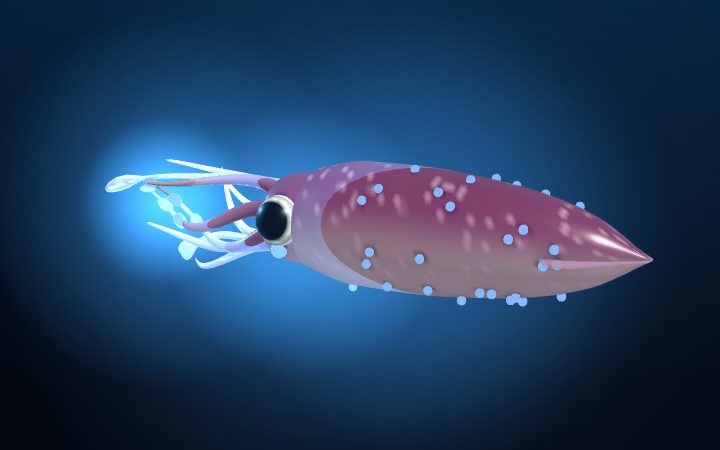
A small conical mantle with short arms, blue light spots scattered over the whole body, and three especially bright, large light organs at the tip of each of the fourth pair of arms
More about this creature
Where and how deep it lives
It lives in the seas around Japan and the deep western Pacific. The water it occupies by day, at 300–400 m, is about 3–6 °C, while the 20–60 m layer it rises to at night is about 5–15 °C, so it crosses a sizeable temperature gap each day.
Food and hunting
Newly hatched paralarvae eat mainly copepods, while older squid also take planktonic crustaceans, fish and other squid. A long caecum is thought to help it absorb nutrients during the day, when its metabolism slows.
Body and adaptations
It carries three kinds of light organs: 800–1,000 small photophores scattered over the underside, five around the lower edge of each eye, and three very large ones at the tip of each fourth arm. The body organs emit blue and green light, those at the eyes and arm tips blue only, and the light is cast downward in a cone. It is used for counter-illumination, matching the brightness of light from above to erase the squid's silhouette from predators looking up, and it may also lure prey.
Whereas other glowing squid borrow light from symbiotic bacteria, the firefly squid is the only organism known to make light using proteins packed into crystals. The three proteins found in the crystals of its arm-tip organs belong to the same protein superfamily as firefly light-producing enzymes, showing that two very distant animals evolved light independently using related enzymes. Its eyes lack a cornea and have a spherical lens and a large pupil.
Life cycle and behaviour
It lives for about a year. Females return inshore to lay eggs, roughly from February to July, and die soon afterwards. A 2020 study near the Oki Islands found that 95% of females examined carried sperm from just one male, supporting the idea that they mate with a single partner. Males mature before females and can mate only about two or three times. Northern fur seals appear to depend heavily on this squid, especially during its migration.
Humans and conservation
It is caught near the surface at night and with nets by day, and Japan's commercial catch ran at about 4,800–6,800 tonnes a year in 1990–1999. In the spawning season, tourists come to watch the blue light in the bay. It is eaten boiled, as sashimi and sushi, salted and fermented as shiokara, and in gunkan-maki; raw eating was once avoided because of the parasitic nematode Crassicauda giliakiana, but cold treatment under food-safety standards now allows it to be served raw.
Sources & further reading
- Firefly squid — Wikipedia en.wikipedia.org
- Glow in the dark – firefly squid and bioluminescence — RNZ (2016) www.rnz.co.nz