Bloodybelly comb jelly
Scientific name: Lampocteis cruentiventer
The Bloodybelly comb jelly is a sea creature that lives in open water at depths of about 250–1,500 m, growing to about 16 cm. In Abyss Dive you meet it at 620 m, in the Twilight Zone (Mesopelagic).
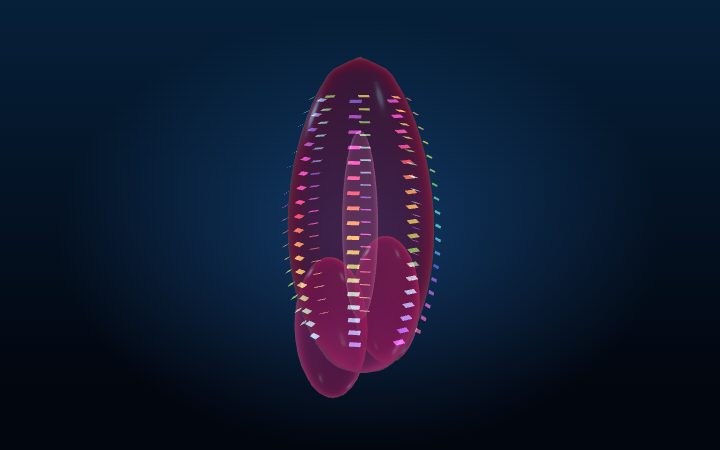
- Depth range
- about 250–1,500 m
- Max size
- about 16 cm
- Zone in this guide
- Twilight Zone 200–1,000 m
- Bioluminescence
- No
- Habitat
- Open water (swimming)
- Depth in the 3D dive
- 620 m
What is it?
A deep red, purple and black comb jelly that lives in the North Pacific at several hundred meters down to 1,500 m. Its comb-row cilia shimmer in rainbow colors.
Did you know?
If prey it has swallowed glows inside its body, that light would give the jelly away. The dark red belly is thought to hide it.
What it looks like
A broad, sac-shaped body with a pair of large lobes hanging to the sides, deep crimson to purple, with eight vertical comb rows shimmering in rainbow colors
More about this creature
Where and how deep it lives
This comb jelly has been recorded across the North Pacific from Canada to Baja California and off Japan, and in 2021 it was added to a checklist of ctenophores in Mexican waters. It lives at about 250–1,500 m and also occurs in the oxygen minimum zone, where oxygen is very scarce.
Food and hunting
Its diet hasn't been confirmed, and MBARI lists it as unknown. Because many animals at these depths are bioluminescent, it probably eats glowing prey.
Body and adaptations
Specimens have measured about 1.5–16 cm long and 1.2–10 cm wide. Color varies from deep red, purple or black to pale purple, and the body itself is translucent. It swims by beating rows of hair-like cilia arranged like combs.
All of its internal meridional canals end blindly, and a deep notch cuts through the body between the comb rows on the tentacle side. These anatomical details set it apart from other lobate comb jellies.
Humans and conservation
It was first collected off San Diego in 1979 but not formally described until 2001, when Harbison and MBARI's Matsumoto and Robison named it as a new genus and species and created a new family, Lampoctenidae, for it alone.
The genus name comes from Greek words for 'bright comb', and the species name from Latin for 'blood-red belly'. MBARI's ROVs have filmed it regularly, and in 2021 it was included in a study that used mitochondrial genes to uncover hidden ctenophore diversity.
Sources & further reading
- Lampocteis — Wikipedia en.wikipedia.org
- Bloody-belly comb jelly — MBARI www.mbari.org