Southern elephant seal
Scientific name: Mirounga leonina
The Southern elephant seal is a sea creature that lives in open water at depths of about 0–2,388 m, growing to about 5.8 m. In Abyss Dive you meet it at 700 m, in the Twilight Zone (Mesopelagic).
- Depth range
- about 0–2,388 m
- Max size
- about 5.8 m
- Zone in this guide
- Twilight Zone 200–1,000 m
- Bioluminescence
- No
- Habitat
- Open water (swimming)
- Depth in the 3D dive
- 700 m
What is it?
The largest pinniped (the group of seals and sea lions). Adult males are about 5 m long and weigh over 3 tonnes. It dives for over 20 minutes at a time, again and again, hunting squid and fish at 400–1,000 m.
Did you know?
Recorded diving to about 2,388 m, it's the deepest-diving air-breathing animal apart from the whales.
What it looks like
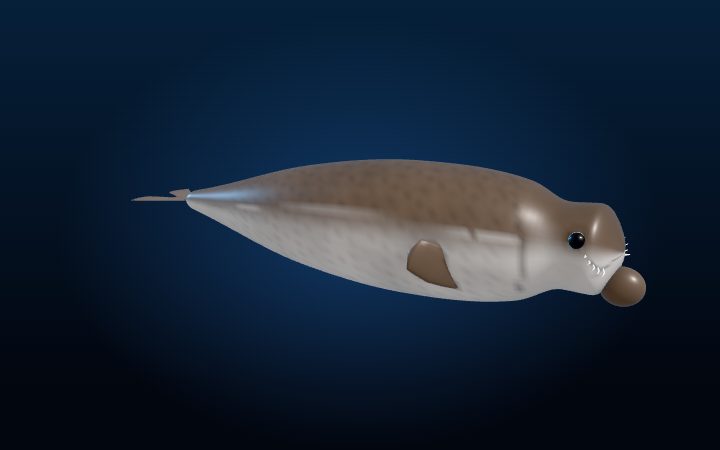
A stout, spindle-shaped gray-brown body, a pair of short front flippers, a pair of fan-shaped rear flippers trailing behind, a drooping trunk-like nose in males, and large dark eyes
More about this creature
Where and how deep it lives
Southern elephant seals range around the Southern Ocean and breed on subantarctic islands. The main colonies are on South Georgia, Kerguelen, Heard Island and Macquarie Island, plus Argentina's Península Valdés, the only breeding site on a continent. The total population was estimated at close to 700,000 around 2025, with about 113,000 breeding females on South Georgia alone.
To feed, they travel thousands of kilometers from their breeding islands to the edge of the Antarctic continent and the sea ice. Males tend to forage on the Antarctic continental shelf, while females work more open water in the pack ice and near the Antarctic Polar Front, and individuals return to the same hunting grounds year after year.
Food and hunting
They live mainly on deep-sea squid and fish, including lanternfish, nototheniids and icefish, as well as krill and other crustaceans and a little algae. They feed most successfully where Circumpolar Deep Water wells up within the Antarctic Circumpolar Current.
According to the Australian Antarctic Division, most dives last about 30 minutes and reach 300–800 m, with only about two minutes at the surface between dives. The longest dives last around two hours.
Body and adaptations
Females weigh about 350–900 kg and measure 2.6–3 m, while adult bulls reach about 3,000–3,700 kg and 4.6–5.8 m. Males are four to five times heavier than females, possibly the greatest difference in body mass between the sexes of any mammal. Seals from South Georgia are on average about 30% heavier and 10% longer than those from Macquarie Island.
Long dives depend on storing extra oxygen and using less of it underwater. Vision matters most in hunting and the whiskers may help find prey, but unlike toothed whales they can't echolocate. Dense networks of blood vessels in the flippers help them hold on to body heat.
Life cycle and behaviour
The breeding season runs from late September to early November. Males haul out first and fight for harems, and a dominant bull may control several dozen females. Bulls can go more than three months without eating while they guard their territory, though fights are rarely fatal.
Pups are born with black fur and weigh about 40 kg. The mother fasts while nursing for about three and a half weeks, by which time the pup weighs around 120–130 kg, and large weaners exceed 220 kg. Shortly before weaning she mates with the dominant bull, and adults come ashore again to molt between January and April. Weaned pups and juveniles are sometimes taken by orcas and leopard seals.
Humans and conservation
In the 19th and early 20th centuries, once fur seals had been depleted, sealers turned to elephant seals for their oil and nearly wiped out many colonies. The species recovered, but populations in the Indian and Pacific oceans declined after the 1950s for reasons that remain unclear.
Most breeding sites are now protected by treaty, UNESCO World Heritage status or national law, the species is listed on CITES Appendix II, and the Australian Antarctic Division describes it as Least Concern on the IUCN Red List. Seals fitted with satellite-relay data loggers have gathered physical and biological ocean data for more than a decade, acting as observers in waters ships rarely reach.
Sources & further reading
- Southern elephant seal — Wikipedia en.wikipedia.org
- Southern elephant seal — Australian Antarctic Division www.antarctica.gov.au