Glass squid
Scientific name: Cranchia scabra
The Glass squid is a bioluminescent (light-making) sea creature that lives in open water at depths of about 2–2,000 m, growing to about 20 cm. In Abyss Dive you meet it at 470 m, in the Twilight Zone (Mesopelagic).
- Depth range
- about 2–2,000 m
- Max size
- about 20 cm
- Zone in this guide
- Twilight Zone 200–1,000 m
- Bioluminescence
- Yes
- Habitat
- Open water (swimming)
- Depth in the 3D dive
- 470 m
What is it?
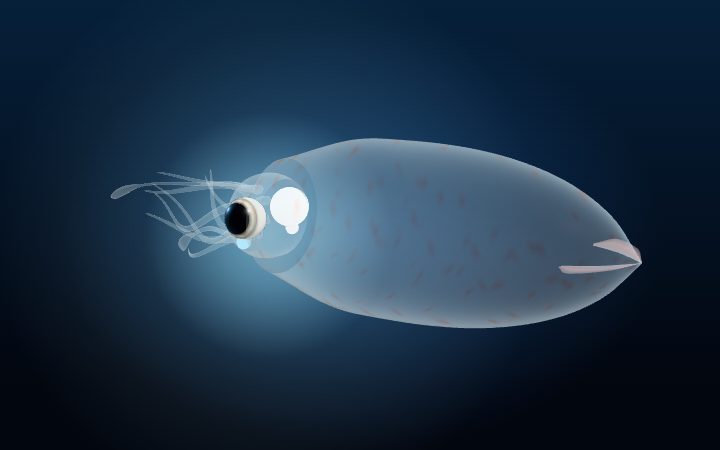
A squid so transparent that only its opaque eyes and digestive gland show through. Young ones live a few hundred meters up, then adults descend to nearly 2,000 m. When threatened, it puffs up like a ball and tucks its arms around itself to hide.
Did you know?
Its body cavity is filled with an ammonium solution lighter than seawater, so it floats with almost no effort.
What it looks like
A ball-like, transparent mantle with small bumps on the surface, a pair of small round fins at the tip, short arms, an orange digestive gland showing through the body, and light organs under the eyes
More about this creature
Where and how deep it lives
This squid lives in the open ocean throughout the tropics and subtropics, recorded from about 43°N to 35°S and generally bounded by the northern and southern subtropical convergences. Hatchlings and juveniles stay in roughly the upper 400 m, growing fast in food-rich surface waters for their first four to five months before moving deeper to mature and spawn.
Food and hunting
Little is recorded about its diet, but it is known to take small fish, crustaceans and other animals small relative to its own size.
Body and adaptations
The mantle is studded with cartilaginous tubercles, ranging from small simple bumps to larger ones shaped like a Maltese cross, which may offer some protection. It usually keeps its chromatophores closed, staying transparent. The mantle grows to about 15–20 cm.
It has light organs around the eyes, and females also have them on their arm tips, possibly to attract mates. Inside, a horizontal partition divides the mantle cavity into two upper chambers and one lower chamber.
Life cycle and behaviour
When it balls up, it may squirt ink into its mantle cavity, turning the ball opaque; what the ink is for is unknown. It can also jet backward three to four body lengths with a hard mantle contraction, though it rarely does.
The sexes are separate. Males display to attract females, then insert a modified arm (the hectocotylus) into the female's mantle cavity to fertilize her. Hatchlings drift as plankton. It is one of the fastest-growing squids: the oldest immature individuals studied were 166 days old with mantles of about 11–12 cm. Its lifespan is unknown.
Humans and conservation
William Elford Leach described the species in 1817, and the genus name honors the naturalist John Cranch. It isn't fished, and the IUCN Red List rates it Least Concern (2010 assessment).
Sources & further reading
- Cranchia scabra — SeaLifeBase www.sealifebase.se
- Cranchia scabra — Wikipedia en.wikipedia.org