Cookiecutter shark
Scientific name: Isistius brasiliensis
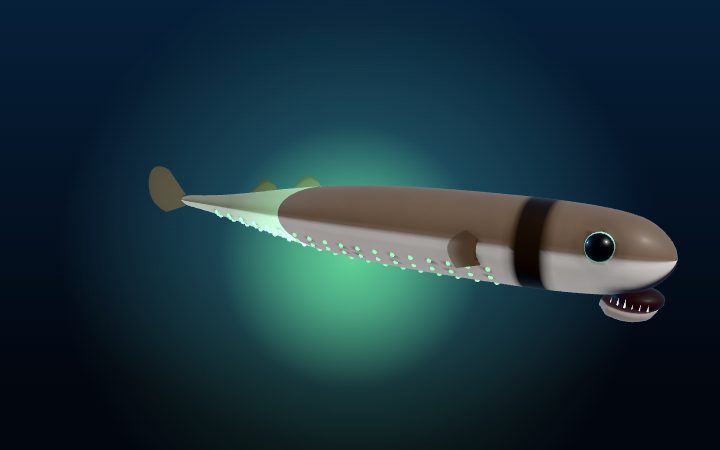
The Cookiecutter shark is a bioluminescent (light-making) sea creature that lives in open water at depths of about 0–3,700 m, growing to about 56 cm. In Abyss Dive you meet it at 500 m, in the Twilight Zone (Mesopelagic).
- Depth range
- about 0–3,700 m
- Max size
- about 56 cm
- Zone in this guide
- Twilight Zone 200–1,000 m
- Bioluminescence
- Yes
- Habitat
- Open water (swimming)
- Depth in the 3D dive
- 500 m
What is it?
A small shark, only a little over 50 cm long, yet it latches onto larger animals such as whales and tuna with its lips and twists around to cut out a round plug of flesh. It's known to travel 2,000–3,000 m up and down every day.
Did you know?
Its underside glows green. It has been recorded glowing for up to about 3 hours after death.
What it looks like
A thin, cigar-shaped brown body, a blunt, short snout, large triangular saw-like teeth in the lower jaw, and a belly that glows green all over except for a dark collar around the throat
More about this creature
Where and how deep it lives
The cookiecutter is most common between 20°N and 20°S, where surface water is about 18–26 °C, and is often found near islands. It has been recorded from the Bahamas, southern Brazil, Cape Verde and South Africa in the Atlantic; from Mauritius to Japan, New Zealand and Hawaii in the Indo-Pacific; and at Easter Island and the Galápagos in the eastern Pacific.
By day it stays below about 1,000 m (the deepest record is about 3,700 m); at night it rises and usually stays above 85 m, occasionally reaching the surface. Bite wounds on marine mammals suggest it may reach California in warm years.
Food and hunting
Its targets range from tuna, swordfish, whales, dolphins and orcas to large sharks such as great whites. A typical crater wound is about 5 cm across and 7 cm deep, and off Hawaii nearly every adult spinner dolphin carries its scars.
It doesn't live on stolen flesh alone: smaller prey such as squid with 15–30 cm mantles, bristlemouths and copepods are swallowed whole.
Body and adaptations
Males reach about 42 cm and females about 56 cm. The liver can make up about 35% of body weight and is rich in low-density oil, helping the shark stay neutrally buoyant. Light organs cover the underside except for a dark collar around the throat and gill slits.
It has 30–37 teeth in the upper jaw and 25–31 in the lower. The lower teeth are shed as a complete row rather than one by one. One shark was estimated to have gone through 15 sets, some 435–465 teeth, while growing from 14 cm to 50 cm, and it swallows the old teeth, apparently to recycle their calcium.
Life cycle and behaviour
The embryos develop inside the mother without a placenta, living on yolk. Litters contain 6–12 pups about 14–15 cm long. Males mature at about 36 cm and females at about 39 cm.
Humans and conservation
French naturalists Quoy and Gaimard described it from a specimen taken off Brazil during the 1817–1820 voyage of the corvette Uranie, publishing in 1824. Theodore Gill coined the genus name Isistius in 1865, after Isis, the Egyptian goddess of light. Only in 1971 was this shark identified as the cause of the round wounds on whales and fish.
In the 1970s and 1980s it damaged a number of US Navy submarines, a problem fixed with fiberglass covers, and it has also bitten undersea cables and oceanographic equipment. A handful of bites on people have been reported, mostly long-distance swimmers crossing Hawaiian channels, but its small size means it isn't considered dangerous. The IUCN Red List rates it Least Concern.
Sources & further reading
- Isistius brasiliensis — FishBase www.fishbase.se
- Cookiecutter shark — Wikipedia en.wikipedia.org