Sperm whale
Scientific name: Physeter macrocephalus
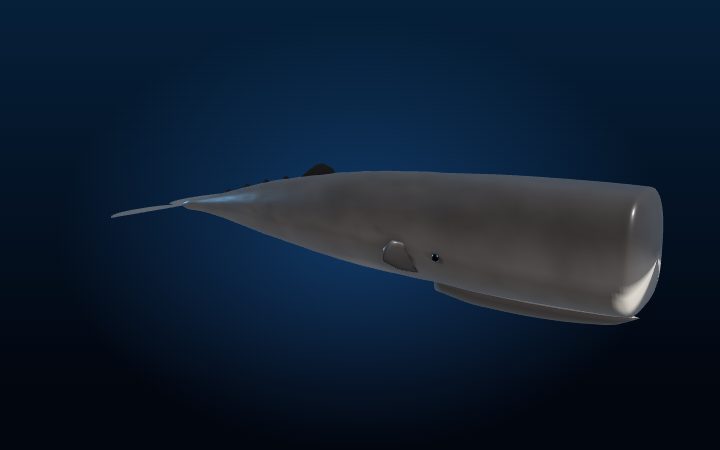
The Sperm whale is a sea creature that lives in open water at depths of about 0–2,250 m, growing to about 19 m. In Abyss Dive you meet it at 940 m, in the Twilight Zone (Mesopelagic).
- Depth range
- about 0–2,250 m
- Max size
- about 19 m
- Zone in this guide
- Twilight Zone 200–1,000 m
- Bioluminescence
- No
- Habitat
- Open water (swimming)
- Depth in the 3D dive
- 940 m
What is it?
The largest of the toothed whales, with a huge boxy head. It takes a single breath, then dives for over an hour to hunt cephalopods such as giant squid in the deep.
Did you know?
It has the largest brain of any animal (about 7 kg on average, over 9 kg for the largest), and has been recorded diving to about 2,250 m.
What it looks like
A blunt, box-shaped head making up a third of the body length, cone-shaped teeth only in the slim lower jaw, wrinkled dark gray skin, low humps on the back, and a broad triangular tail
More about this creature
Where and how deep it lives
Sperm whales live in every ocean and favor ice-free water more than 1,000 m deep. Females and young stay in tropical and temperate seas, while only adult males travel to cold high latitudes.
A typical dive is often given as about 400 m and 35 minutes, while NOAA cites about 600 m (2,000 ft) and around 45 minutes. Between dives they rest at the surface for up to about ten minutes.
Food and hunting
They eat mainly medium-sized squid, along with giant and colossal squid, octopuses and some fish. In one Galápagos study, 62% of the squid taken belonged to Histioteuthis, the genus of the strawberry squid. NOAA adds sharks, skates and deep-water fish to the menu, and estimates that they eat about 3–3.5% of their body weight a day.
Body and adaptations
Adult males average about 16 m and 45 tonnes, females about 11 m and 15 tonnes, so males are 30–50% longer and about three times heavier. The head takes up a quarter to a third of the body, and the spermaceti organ inside can hold up to about 1,900 liters of waxy oil. Each side of the lower jaw carries 18–26 teeth weighing up to 1 kg each, while the upper teeth rarely emerge. The skin on the back is wrinkled like a prune.
Life cycle and behaviour
Females and young live in matriarchal units of usually 6–9 animals, sometimes more than 20. Young males leave between 4 and 21 years of age, join bachelor groups and become increasingly solitary, joining females only to breed. Their echolocation clicks reach source levels of about 230–236 dB, the loudest of any animal, and they communicate with codas, patterns of 3–12 clicks. Differences in coda use define seven clans in the Pacific and four in the Atlantic.
Females mature at around nine years old and, after a 14–16-month pregnancy, give birth to a single calf about 4 m long and weighing about a tonne. The milk is about 36% fat and nursing lasts 19–42 months. Calving intervals of 4–20 years have been reported, though NOAA gives 5–7 years as typical. They live for an estimated 60 to more than 70 years.
Humans and conservation
Spermaceti was prized for lamp oil, lubricants and candles, and ambergris, formed in the gut, for perfume, making sperm whaling a major 19th-century industry. Commercial whaling from the 1800s to the 1980s greatly reduced their numbers, and the International Whaling Commission adopted a moratorium on commercial whaling in 1986.
The species is listed as Vulnerable on the IUCN Red List and on CITES Appendix I, and it has been endangered under the US Endangered Species Act since 1970. Numbers appear to be recovering, but vessel strikes, entanglement in pot lines and gillnets, ocean noise and marine debris mistaken for prey remain threats. Their habit of taking fish off longlines also brings them into conflict with fisheries.
Sources & further reading
- Sperm whale — Wikipedia en.wikipedia.org
- Sperm Whale — NOAA Fisheries www.fisheries.noaa.gov