Silver chimaera
Scientific name: Chimaera phantasma
The Silver chimaera is a sea creature that lives in open water at depths of about 60–550 m, growing to about 1 m. In Abyss Dive you meet it at 460 m, in the Twilight Zone (Mesopelagic).
- Depth range
- about 60–550 m
- Max size
- about 1 m
- Zone in this guide
- Twilight Zone 200–1,000 m
- Bioluminescence
- No
- Habitat
- Open water (swimming)
- Depth in the 3D dive
- 460 m
What is it?
A fish from the chimaeras, a group that, like sharks and rays, has a skeleton of cartilage but split off from them long ago. It lives near the bottom along the edge of the continental shelf and on the continental slope off Korea, Japan and China, feeding on small bottom-dwelling animals.
Did you know?
Its eggs are laid inside tough, horny capsules. Though related to sharks, it crushes its food with plate-like tooth plates instead of teeth.
What it looks like
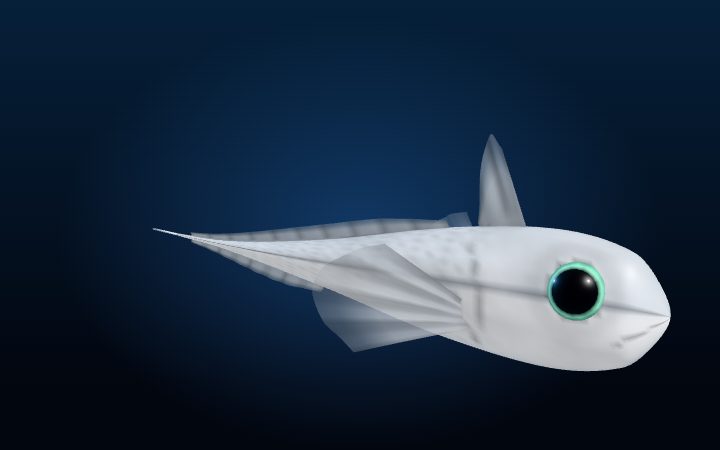
A silvery body tapering from a large head and big eyes to a whip-thin tail, wide wing-like pectoral fins, a spine in front of the tall first dorsal fin, and a thread-like tail tip
More about this creature
Where and how deep it lives
The silver chimaera ranges through East Asia from northern Japan to northern Indonesia, including the waters off Korea, China, Taiwan and the Philippines. In the East China Sea it lives near the bottom on the continental shelf and upper slope. FishBase gives a depth range of about 90–540 m, but other records span roughly 20–960 m, with the species most common around 500 m.
Food and hunting
It hunts along the bottom, tracking prey with its electrosensory ampullae of Lorenzini and a keen sense of smell. It crushes hard-shelled crustaceans, molluscs and echinoderms with its tooth plates, and also takes soft-bodied animals such as anemones, sea squirts, jellyfish, polychaete worms and salps.
Body and adaptations
It reaches about 1–1.1 m, a third of which is a thin, whip-like tail. The silvery body has dark stripes along the sides, and the pectoral fins span about a third of the body length. The first dorsal fin is tall, narrow and triangular, with a single hard spine at the front.
Unlike sharks, it has no row of separate gill slits: four gill openings sit under a single cover, and there are no spiracles. It has two pairs of tooth plates in the upper jaw and one pair in the lower jaw, and they keep growing throughout life.
Life cycle and behaviour
Fertilization is internal. Males carry a pair of three-pronged pelvic claspers plus a single clasper on the forehead. Mating runs roughly from autumn to spring and peaks in winter. Females lay bottle-shaped egg cases holding one egg each, one or two at a time, and the eggs hatch after about eight months.
Fish mature only above about 65 cm, and the average generation length is estimated at about 18.6 years. FishBase rates its resilience as low, with a population doubling time of 4.5–14 years.
Humans and conservation
David Starr Jordan and John Otterbein Snyder described the species in 1900. It isn't a target species, but it is a common bycatch in trawls, kept only when enough is caught to sell and otherwise discarded. In Japan it is used in fish paste (kamaboko), and it is also reported in Chinese medicine.
The IUCN Red List lists it as Vulnerable, estimating a 30–49% decline over the past 50 years based on local data for cartilaginous fishes. Trawling in the region has become much less common in recent decades.
Sources & further reading
- Chimaera phantasma — FishBase www.fishbase.se
- Silver chimaera — Wikipedia en.wikipedia.org