Humboldt squid
Scientific name: Dosidicus gigas
The Humboldt squid is a sea creature that lives in open water at depths of about 0–700 m, growing to about 1.5 m. In Abyss Dive you meet it at 300 m, in the Twilight Zone (Mesopelagic).
- Depth range
- about 0–700 m
- Max size
- about 1.5 m
- Zone in this guide
- Twilight Zone 200–1,000 m
- Bioluminescence
- No
- Habitat
- Open water (swimming)
- Depth in the 3D dive
- 300 m
What is it?
A large squid of the eastern Pacific with a mantle up to about 1.5 m long. It lives mostly at 200–700 m and hunts in groups.
Did you know?
Around other squid, it flashes its whole body between red and white two to four times per second to communicate.
What it looks like
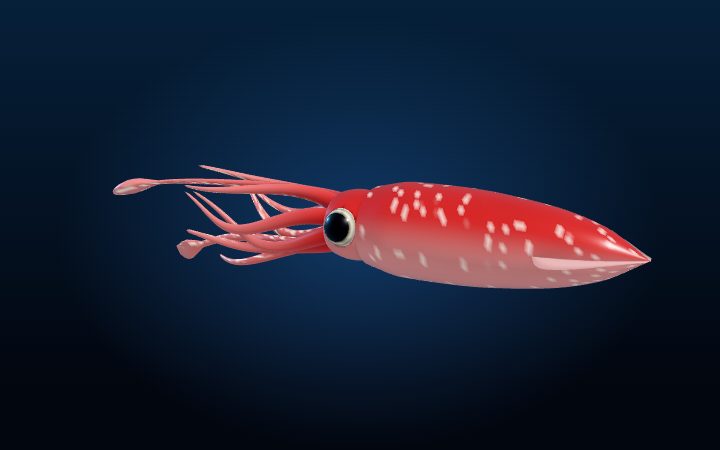
A thick, conical red mantle with diamond-shaped fins at the tip, big eyes, eight stout arms and two long tentacles; the body color flashes between red and white
More about this creature
Where and how deep it lives
It lives in the eastern Pacific from Tierra del Fuego to California and has recently spread north to Oregon, Washington, British Columbia and Alaska. Electronic tags show it moving close to the surface from dusk to dawn. It is known to spawn off Mexico and Baja California in winter, head north in spring and summer and return south in autumn.
It spends much of its time in deep, low-oxygen water with very little light; researcher William Gilly says it prefers conditions 'just barely brighter than a moonless night'. As oxygen minimum zones grow shallower worldwide, prey is pushed up into brighter water where the squid can hunt more easily, one suggested factor in its range expansion. It has made intermittent incursions into California waters since the late 1800s, arriving in force during the 1997 El Niño, returning in 2002 for an eight-year stay and retreating with the 2009 El Niño.
Food and hunting
It eats lanternfish, crustaceans, other cephalopods and copepods. Cannibalism is common: about a quarter of stomachs analysed contained remains of other Humboldt squid, and in a Chilean study of more than 2,000 squid, over half held beaks of their own species.
Body and adaptations
It can weigh up to about 50 kg, and females mature at larger sizes than males. Roughly 56–62% of its mass is mantle, 11–15% arms and tentacles and 10–13% head. It can swim at up to about 24 km/h and forms shoals of up to 1,200 individuals.
Life cycle and behaviour
It lives for about a year, and up to two years for larger individuals. Females lay gelatinous egg masses holding from about 5,000 to 4.1 million eggs, and a large female's egg mass can measure 3–4 m across. When food is short, the squid adjust their life cycle, maturing earlier, breeding at a smaller size and dying sooner.
Humans and conservation
It is the most important squid for commercial fisheries, accounting for about a third of all squid caught worldwide as of 2019. Peru and Chile each landed hundreds of thousands of tonnes a year in 2005–2007, mostly by jigging at night under bright lights. Fishers in Baja California call it 'diablo rojo', the red devil, for its flashing colours. The Gulf of California fishery collapsed amid warm water in 2015 and has not recovered.
Attacks on divers have been reported, mostly during feeding, and some scientists suggest reflective gear or lights provoked them. Chilean researchers in the 1950s and 1960s used its giant nerve fibres (axons) for neurophysiology research. The IUCN lists it as Data Deficient.
Sources & further reading
- Humboldt squid — Wikipedia en.wikipedia.org
- Jumbo squid have left — Bay Nature baynature.org