Seven-arm octopus
Scientific name: Haliphron atlanticus
The Seven-arm octopus is a sea creature that lives in open water at depths of about 0–6,790 m, growing to about 2.9 m. In Abyss Dive you meet it at 1,000 m, in the Midnight Zone (Bathypelagic).
- Depth range
- about 0–6,790 m
- Max size
- about 2.9 m
- Zone in this guide
- Midnight Zone 1,000–4,000 m
- Bioluminescence
- No
- Habitat
- Open water (swimming)
- Depth in the 3D dive
- 1,000 m
What is it?
One of the largest octopuses known. A specimen caught at 920 m off New Zealand, with parts missing, was still about 2.9 m long and weighed 61 kg. Its jelly-like body ranges through the open ocean's mesopelagic and bathypelagic zones and along the continental slope.
Did you know?
A male's reproductive arm is coiled up in a pouch under the right eye, so it appears to have only seven arms. It likes to eat gelatinous animals such as jellyfish.
What it looks like
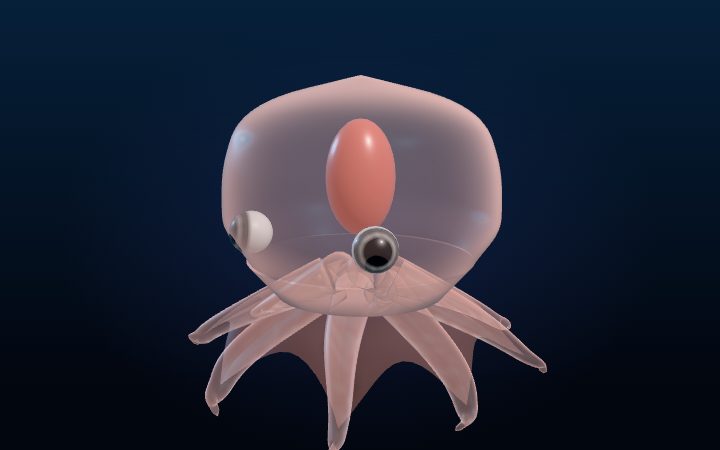
A translucent, pinkish, jelly-like body, a broad web joining eight short arms (one hidden under the eye, so it looks like seven), and a swimming style of opening and closing like an umbrella
More about this creature
Where and how deep it lives
It has been recorded in tropical to temperate seas worldwide. The type specimen came from the Atlantic west of the Azores, and the species has also turned up near South Georgia, off Brazil's Fernando de Noronha archipelago, on the eastern Chatham Rise off New Zealand and in Monterey Bay, California. Sperm whale stomach contents suggest it is more widespread in northern waters than direct catches show.
In the open ocean it has been taken from the surface down to at least about 1,260 m, and bottom trawls on continental shelves and slopes have caught it at roughly 100–3,173 m. It may not be purely midwater: on continental slopes it seems to return to the bottom at times. In November 2000 a female was caught at about 100 m in a Norwegian fjord.
Food and hunting
In July 2013 an MBARI robot filmed a female off California eating an egg-yolk jellyfish (Phacellophora camtschatica), an observation published in Scientific Reports in 2017. When the researchers checked museum specimens collected in the 1970s and 1990s, every stomach held remains of gelatinous animals such as jellies and salps. A slow metabolism probably lets it live on such low-calorie food.
The jelly in the 2013 footage was missing its stomach, the most nutritious part, and the octopus is known to target the stomach and reproductive organs of its prey. In November 2025 an animal believed to be a male was filmed at about 700 m in Monterey Bay clutching a helmet jelly. Some sources also list crustaceans and cephalopods as food.
Body and adaptations
It actually has eight arms. Its tissue is so gelatinous that the male's mating arm, coiled in a sac beneath the eye, is easy to miss. Older animals have shorter bodies and longer arms than juveniles; the young are translucent, while adults range from blue to red.
In females the arms and the webbing between them form a deep umbrella that is thought to be the main means of swimming. The largest specimen known is estimated at about 3.5 m long and 75 kg, and the 2002 New Zealand animal had a mantle about 0.69 m long. Males are dwarfs, only about 5–15% the size of the largest females.
Life cycle and behaviour
Females brood their eggs attached to the inner side of the arm bases near the mouth and probably spawn in batches. An egg string with embryos collected north of the Cape Verde Islands had eggs about 8 mm wide. The male's mating arm detaches when mature; mating is thought to happen sporadically along continental coasts but has hardly been studied.
Known predators include blue sharks, sperm whales, Hawaiian monk seals and swordfish, with lancetfish and some tunas taking it occasionally. Cory's shearwaters eat individuals that other predators have driven to the surface.
Humans and conservation
Steenstrup described the species in 1861, and the type specimen is held by the University of Copenhagen's Zoological Museum. The giant 2002 New Zealand specimen was reported in the New Zealand Journal of Zoology in 2004. COI gene analysis of a Brazilian specimen suggests there may be two species: one in the North Atlantic and another in the South Atlantic and Pacific.
The IUCN Red List rates it Least Concern (2014 assessment). Live encounters are rare; even MBARI, which has surveyed Monterey Bay for decades, has seen it only four times in nearly 40 years.
Sources & further reading
- Seven-arm octopus — Wikipedia en.wikipedia.org
- Haliphron atlanticus — SeaLifeBase www.sealifebase.se
- MBARI researchers encounter rarely seen deep-sea seven-arm octopus — MBARI www.mbari.org
- Rare Sighting Reveals Deep-Sea Octopus's Unusual Breakfast — Scientific American www.scientificamerican.com