Atolla jellyfish
Scientific name: Atolla wyvillei
The Atolla jellyfish is a bioluminescent (light-making) sea creature that lives in open water at depths of about 1,000–4,000 m, growing to about 17 cm. In Abyss Dive you meet it at 1,850 m, in the Midnight Zone (Bathypelagic).
- Depth range
- about 1,000–4,000 m
- Max size
- about 17 cm
- Zone in this guide
- Midnight Zone 1,000–4,000 m
- Bioluminescence
- Yes
- Habitat
- Open water (swimming)
- Depth in the 3D dive
- 1,850 m
What is it?
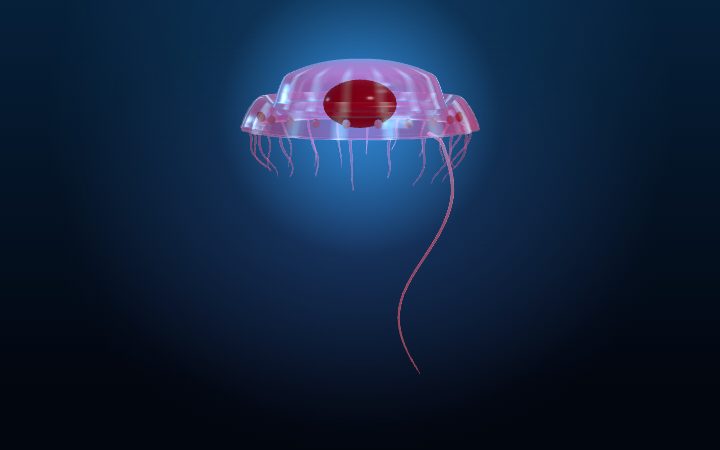
A deep-sea jellyfish with a dark red bell. At depths red light never reaches, its red body is nearly invisible. It trails one tentacle much longer than the others.
Did you know?
When attacked, it sets off a 'burglar alarm': blue light whirling around the rim of its bell. This is thought to attract a bigger predator that will go after the attacker.
What it looks like
A flat, disc-shaped, dark red bell, a scalloped edge with about twenty short tentacles, one of them trailing very long, and a blue ring of light circling the bell
More about this creature
Where and how deep it lives
It lives in deep water around the world and is counted among the most common jellies of the deep sea. Atolla wyvillei has been documented at about 1,000–4,000 m, and MBARI describes the genus as a whole as living in midwater at about 500–5,000 m.
Food and hunting
It eats plankton, including crustaceans and other gelatinous animals. Its one extra-long tentacle can stretch to about six times the width of the bell; the jelly either trails it while swimming to snag crustaceans or leaves it hanging to catch drifting prey.
Body and adaptations
Bell diameters reported for this species range from about 2 cm to a little over 17 cm, and MBARI gives about 15 cm as the maximum for the genus. The bell margin usually carries around 20 tentacles, plus the single long one.
When attacked, it sends rings of blue light racing around the bell at about 5–50 cm per second, which MBARI says can also disorient the attacker. Deep-sea explorer Edith Widder built a device mimicking this pattern, the e-jelly, and used it on an expedition backed by the Discovery Channel and NHK to lure in a giant squid.
Humans and conservation
Ernst Haeckel described it in 1880, naming it after Sir Charles Wyville Thomson, chief scientist of the Challenger expedition. About ten Atolla species are now recognised, and in 2022 MBARI described a look-alike without the long trailing tentacle as a new species, Atolla reynoldsi. There is evidence that shrimps threaten it, but its predators and reproduction remain poorly documented.
Sources & further reading
- Atolla jellyfish — Wikipedia en.wikipedia.org
- Atolla jelly — MBARI Animal Guide www.mbari.org