Black swallower
Scientific name: Chiasmodon niger
The Black swallower is a sea creature that lives in open water at depths of about 0–2,745 m, growing to about 25 cm. In Abyss Dive you meet it at 1,750 m, in the Midnight Zone (Bathypelagic).
- Depth range
- about 0–2,745 m
- Max size
- about 25 cm
- Zone in this guide
- Midnight Zone 1,000–4,000 m
- Bioluminescence
- No
- Habitat
- Open water (swimming)
- Depth in the 3D dive
- 1,750 m
What is it?
A black deep-sea fish about 25 cm long. Young ones live in shallow water, and adults move down below about 750 m.
Did you know?
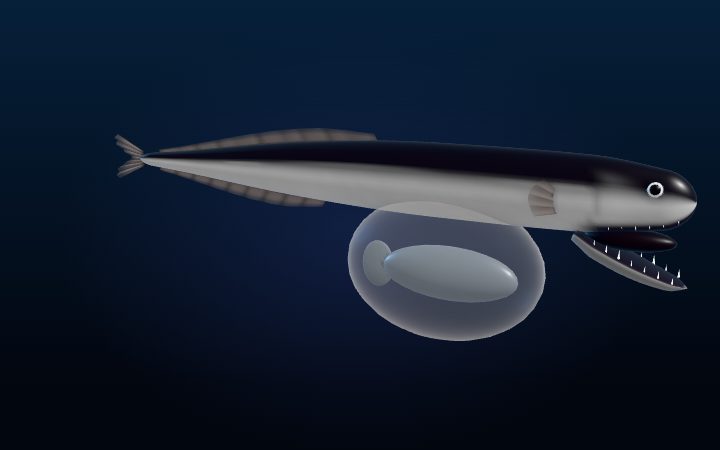
It can swallow whole a fish longer than itself. The stomach inflates like a balloon until the swallowed prey shows through the translucent belly.
What it looks like
A slender black body, a mouth whose jaws open wide with inward-curving teeth, and a translucent stomach hanging from the belly like a ball (prey visible inside)
More about this creature
Where and how deep it lives
FishBase lists the North Atlantic including the Gulf of Mexico (roughly 46°N to 5°S) plus Argentina in the southwest Atlantic, while other sources describe it as living in tropical and subtropical waters worldwide. It is the commonest member of its genus in the North Atlantic.
Most specimens longer than 4.5 cm were taken at about 730–1,900 m (averaging about 1,390 m), with records spanning about 150–3,900 m. Juveniles live at 0–1,050 m (averaging about 542 m), and the smallest were caught closest to the surface.
Food and hunting
It swallows bony fishes and cephalopods whole. Its stretchy stomach can take prey about ten times its own mass, and hinged upper jaws swing down to engulf prey bigger than its head. The ichthyologist Theodore Gill speculated that it seizes prey by the tail and 'walks' its jaws over it until the meal is coiled inside the stomach.
Sometimes the prey is too big to digest before it starts to rot, and the gases released float the fish to the surface; most known specimens were collected that way. In 2007 a dead 19 cm black swallower found off Grand Cayman held an 86 cm snake mackerel, about four and a half times its own length.
Body and adaptations
Adults average 15–20 cm and have an elongated, compressed, scaleless body that is uniformly brownish black. The lower jaw juts beyond the upper, and a single row of sharp teeth in each jaw interlocks when the mouth closes. The first three teeth in each jaw are enlarged into fangs that sit loosely in their sockets and can move, helping to wound and chew prey. A swollen belly in a preserved specimen, however, may be caused by pressure damage during capture rather than by a meal.
Life cycle and behaviour
It lays floating eggs 1.1–1.3 mm across, each with a clear oil droplet and six dark pigment patches. Off South Africa its eggs turn up mostly in winter, and off Bermuda juveniles have been recorded from April to August. Larvae and juveniles are covered in tiny spines; as they grow the pigment patches fade and the whole body turns black.
Humans and conservation
Johnson described it in 1864. It has no fishery value, is harmless to people and is rated Least Concern on the IUCN Red List.
Sources & further reading
- Chiasmodon niger — FishBase www.fishbase.se
- Black swallower — Wikipedia en.wikipedia.org