Bristlemouth
Scientific name: Cyclothone spp.
The Bristlemouth is a bioluminescent (light-making) sea creature that lives in open water at depths of about 300–1,500 m, growing to about 8 cm. In Abyss Dive you meet it at 1,180 m, in the Midnight Zone (Bathypelagic).
- Depth range
- about 300–1,500 m
- Max size
- about 8 cm
- Zone in this guide
- Midnight Zone 1,000–4,000 m
- Bioluminescence
- Yes
- Habitat
- Open water (swimming)
- Depth in the 3D dive
- 1,180 m
What is it?
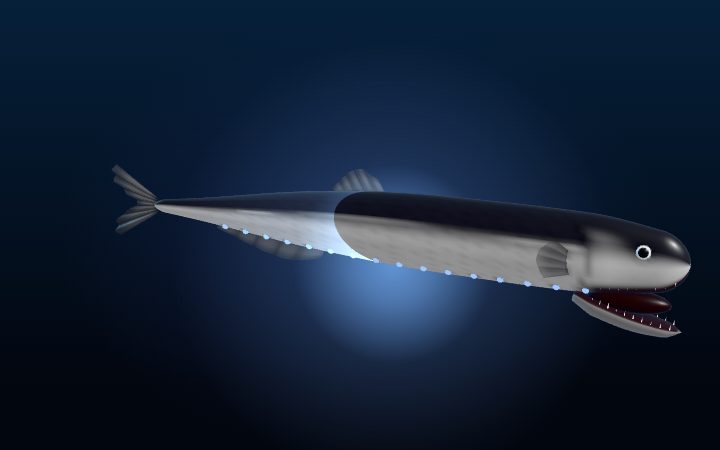
A tiny deep-sea fish only a few cm long. The name 'bristlemouth' comes from the rows of needle-like teeth in its mouth. A line of light spots on its belly gives it counterillumination camouflage.
Did you know?
Thought to be the most abundant genus of vertebrates on Earth, with as many as a quadrillion (1,000 trillion) individuals worldwide.
What it looks like
A slender black body a few cm long, a mouth cleft back past the eyes with rows of needle teeth, very small eyes, and a single row of tiny blue light spots along the belly
More about this creature
Where and how deep it lives
Bristlemouths live in the open ocean from the tropics to temperate latitudes, mostly below 300 m and most commonly at about 300–1,500 m. Each species keeps to its own depth band, and larger species live deeper: adult and juvenile C. braueri occur at about 250–900 m, for example, while C. microdon lives at about 500–2,700 m.
Most species do not make daily vertical migrations. C. braueri in the Atlantic north of 40°N and in the Mediterranean does shift about 200 m with the seasons, sitting shallower in midwinter than in midsummer. Submersible observers have seen adults hanging horizontally in the water.
Food and hunting
Copepods are the main food, but bristlemouths also take arrow worms, krill, mysids and ostracods, and have been found with detritus and faecal pellets in their guts. They are mid-level predators, eating small animals while being eaten by larger deep-sea fishes such as dragonfishes and fangtooths.
Body and adaptations
They are small and elongated with a large mouth, and the swim bladder regresses in adults. Shallow and deep species differ in colour: C. braueri is white with scattered star-shaped pigment cells, while C. microdon is uniformly dark brown except around the throat. Some species, such as C. obscura, have no light organs at all.
Sizes vary too: C. braueri males reach about 26 mm and females about 38 mm, while C. microdon males reach about 49 mm and females about 66 mm. Males have longer gill filaments and a keener sense of smell than females.
Life cycle and behaviour
Larvae drift near the surface and descend to adult depths when they metamorphose at about 11–14 mm. Most species have separate sexes, but some are protandrous, starting life as males and later turning female; in C. microdon the change happens at about 22–42 mm.
C. braueri spawns mainly from April to October, with about 100–900 eggs per pair of ovaries, while C. microdon spawns in summer and autumn and carries about 2,000–10,000. Ripe eggs of both are about 0.5 mm across, and egg numbers rise at higher latitudes.
Humans and conservation
Goode and Bean named the genus in the early 1880s; sources count between 11 and 14 species. Bristlemouths do not survive being brought to the surface, so they cannot be studied alive in the lab. No species is on the IUCN Red List, and none is thought to face an immediate threat.
Microfossils from Southern Ocean sediments show the genus dates back to the earliest Eocene, about 55.6 million years ago. The oldest named fossil species, C. duhoensis, comes from Middle Miocene rocks in South Korea.
Sources & further reading
- Cyclothone — Wikipedia en.wikipedia.org
- Genus Cyclothone — Fishes of the NE Atlantic and Mediterranean (Naturalis) fishes-fnam.linnaeus.naturalis.nl
- Cyclothone microdon — Fishes of the NE Atlantic and Mediterranean (Naturalis) fishes-fnam.linnaeus.naturalis.nl
- Cyclothone braueri — Fishes of the NE Atlantic and Mediterranean (Naturalis) fishes-fnam.linnaeus.naturalis.nl