Orange roughy
Scientific name: Hoplostethus atlanticus
The Orange roughy is a sea creature that lives in open water at depths of about 180–1,810 m, growing to about 75 cm. In Abyss Dive you meet it at 1,040 m, in the Midnight Zone (Bathypelagic).
- Depth range
- about 180–1,810 m
- Max size
- about 75 cm
- Zone in this guide
- Midnight Zone 1,000–4,000 m
- Bioluminescence
- No
- Habitat
- Open water (swimming)
- Depth in the 3D dive
- 1,040 m
What is it?
An orange fish of cold, deep water above continental slopes and seamounts. It grows very slowly and is vulnerable to overfishing; Australia listed it as a threatened species in 2006.
Did you know?
One of the longest-lived fish, with one individual estimated to be about 149 years old.
What it looks like
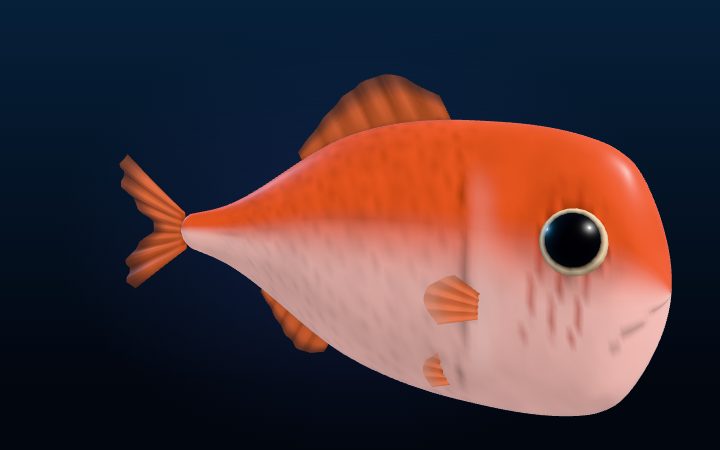
An orange, laterally flattened, egg-shaped body, a large head with prominent bones and big eyes, a ridge of spiny scutes along the belly, and a forked tail
More about this creature
Where and how deep it lives
It occurs in the eastern Atlantic from Iceland to Morocco and from Walvis Bay, Namibia, to off Durban, South Africa, as well as in the south-central Indian Ocean, around New Zealand and Australia, and off Chile. It lives in water of about 3–9 °C and has been recorded from roughly 180 to 1,809 m, most often at 400–900 m.
It gathers over steep slopes, ridges, seamounts and undersea canyons, where currents are strong and water mixes well. Distinct spawning sites and seasons point to several separate stocks; the fish move little between management zones, yet travel several hundred kilometres between spawning and feeding grounds.
Food and hunting
Juveniles eat mostly zooplankton and small crustaceans such as mysids, krill and amphipods. Adults switch to small fishes like lanternfishes, prawns and squid, with squid making up as much as about 20% of the diet.
Juveniles and adults shift their diets in opposite directions with depth, which may reduce competition between them. Diet studies put its trophic level at about 4.3, close to that of a top predator.
Body and adaptations
In life it is brick red, fading to yellowish orange after death. The body is flattened from side to side, and the rounded head carries mucus-filled canals that are part of the lateral line system.
It reaches about 75 cm and 7 kg, though commercial catches are usually 35–45 cm. Growth is extremely slow: when fishing began in the 1970s it was thought to live about 30 years, but radiometric dating and counts of growth rings later showed lifespans well beyond a century.
Life cycle and behaviour
Breeding is generally said to start at about 20 years and 30 cm, but some populations mature much later. A 2022 assessment off New Zealand's North Island found spawning began at about 40 years, and only by about 55 were half the females spawning.
Each year the fish pack densely over seamounts and slopes and release eggs and sperm together, usually from June or July for up to three weeks. The eggs, 2.0–2.5 mm across, carry an oil droplet that floats them up to about 200 m, and they hatch after 10–20 days. Females produce only about 22,000 eggs per kilogram of body weight, less than a tenth of the average for other fishes.
Humans and conservation
New Zealand scientists coined the name orange roughy in 1975 after finding large aggregations, and in the late 1970s a US National Marine Fisheries Service programme helped it replace the less marketable name slimehead. Full-scale fishing began in 1979; global catches peaked above 90,000 tonnes in 1990 and then fell sharply, and by the end of the 1990s three of New Zealand's eight orange roughy fisheries had collapsed and closed.
Almost all fishing is by bottom trawl, which is heavily criticised for damaging habitat. In Australia some stocks had fallen to about 10% of unfished levels by 2008, a few fisheries reopened only in late 2017, and in 2021 an arbitrator ruled that a stock listed under threatened-species law could not be MSC certified. Its flesh carries about 0.30–0.86 ppm mercury, well above the average for edible fish, and the IUCN's European assessment lists it as Vulnerable.
Sources & further reading
- Hoplostethus atlanticus — FishBase www.fishbase.se
- Orange roughy — Wikipedia en.wikipedia.org