Scaly-foot gastropod
Scientific name: Chrysomallon squamiferum
The Scaly-foot gastropod is a sea creature that lives near the seafloor at depths of about 2,400–2,900 m, growing to about 5 cm. In Abyss Dive you meet it at 2,650 m, in the Midnight Zone (Bathypelagic).
- Depth range
- about 2,400–2,900 m
- Max size
- about 5 cm
- Zone in this guide
- Midnight Zone 1,000–4,000 m
- Bioluminescence
- No
- Habitat
- Near the seafloor
- Depth in the 3D dive
- 2,650 m
What is it?
A snail known from only three hydrothermal vent fields in the Indian Ocean. Iron sulfide minerals in the outer layer of its shell and in the scales on its foot make it look as if it's wearing metal armor.
Did you know?
The only living animal known to use iron sulfide in its skeleton. In 2019 it became the first species listed as endangered (EN) because of the threat from deep-sea mining.
What it looks like
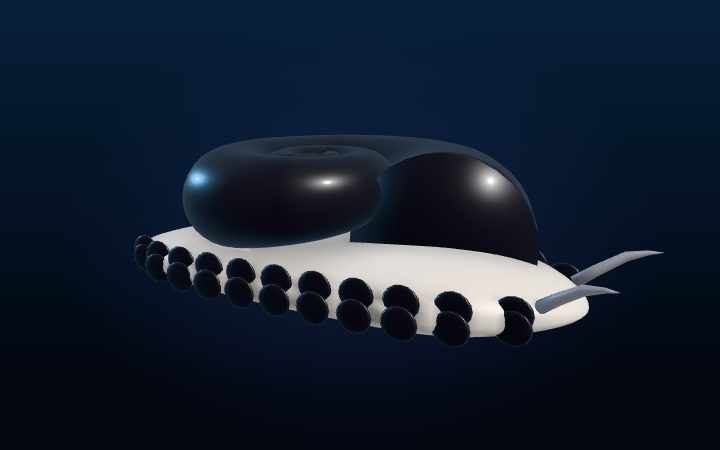
A round spiral shell about 3–4.5 cm across (black, with a metallic sheen), and black scale plates on the sides of the foot below the shell, packed like roof tiles
More about this creature
Where and how deep it lives
It is known from three vent fields on Indian Ocean ridges: Kairei (about 2,415–2,460 m) and Solitaire (about 2,606 m, inside Mauritius's exclusive economic zone) on the Central Indian Ridge, and Longqi (about 2,780 m) on the Southwest Indian Ridge, the type locality. Together the three sites cover less than 0.02 km².
Food and hunting
A gland attached to its oesophagus is so enlarged that it fills about 9.3% of the body, and it houses sulfur-oxidizing gammaproteobacteria. After settling, the snail stops filter-feeding and gets all its nutrition from these symbionts, and its digestive system has shrunk to less than a tenth of the usual gastropod size. In 2014 the symbiont's genome became the first complete genome of a gastropod endosymbiont to be sequenced.
Body and adaptations
The shell has three layers: an outer black layer of iron sulfide (greigite) about 30 μm thick, a brown organic middle layer of about 150 μm, and an inner white aragonite layer of about 250 μm. The middle layer absorbs impacts and dissipates heat, which has drawn interest from researchers designing protective materials. Hundreds of scales (sclerites), each about 1 × 5 mm in adults, armour the sides of the foot and contain greigite and pyrite.
Sclerites from Kairei are ferrimagnetic, while Solitaire snails lack iron and have white scales; genetic work treats the two as forms of one species. The heart takes up about 4% of body volume (a human heart is about 1.3%) and the gill about 15.5%. Shells reach about 45.5 mm wide, much larger than most relatives in its family, which are under 15 mm.
Life cycle and behaviour
It is a simultaneous hermaphrodite with high fecundity. Its eggs are probably yolk-fed, and although larvae had not been seen as of 2016, a drifting dispersal stage is presumed. The smallest juvenile collected had a 2.2 mm shell, and despite being hard to keep, snails have survived more than three weeks in aquaria at surface pressure.
Humans and conservation
The Kairei field was found in 2000, but the snail itself was first collected there in April 2001. Its scientific name was in use from 2003, though the formal description came only in 2015 (Chen and colleagues). For the July 2019 IUCN assessment, the team used the number of vents occupied and the threat of mining as criteria, because standard range-size measures fit vent animals poorly.
Kairei lies within a German exploration licence (2015–2030) and Longqi within a Chinese one (2011–2026), while Solitaire is in Mauritian waters. As of 2017 none of the sites had conservation measures, and the Longqi population is considered especially vulnerable because its ridge spreads slowly and it is poorly connected to the others.