Greenland shark
Scientific name: Somniosus microcephalus
The Greenland shark is a sea creature that lives in open water at depths of about 0–2,992 m, growing to about 5.5 m. In Abyss Dive you meet it at 1,220 m, in the Midnight Zone (Bathypelagic).
- Depth range
- about 0–2,992 m
- Max size
- about 5.5 m
- Zone in this guide
- Midnight Zone 1,000–4,000 m
- Bioluminescence
- No
- Habitat
- Open water (swimming)
- Depth in the 3D dive
- 1,220 m
What is it?
A big, slow shark of the cold North Atlantic and Arctic seas. It stays mostly at 200–600 m, but has been recorded as deep as about 3,000 m.
Did you know?
Radiocarbon dating of eye lenses suggested ages of at least 272 years, and the oldest individual may have lived nearly 400 years. It takes about 150 years just to reach adulthood.
What it looks like
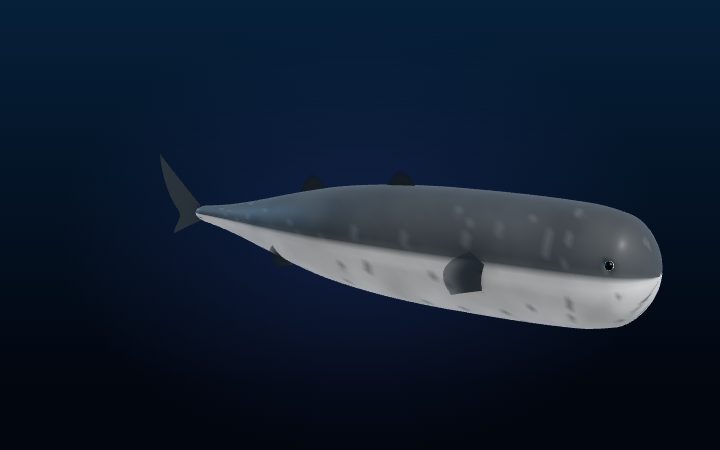
A thick, blunt, cylindrical gray-brown body, a short, rounded snout, two small dorsal fins, very small eyes, and a tail whose upper and lower lobes differ little in length
More about this creature
Where and how deep it lives
It prefers water of about -1.1 to 7.4 °C. FishBase lists a range from the USA and Canada to Greenland and from Portugal to the Barents and East Siberian seas, but genetic work narrows the core range to Canada, Greenland, Iceland, the Faroe Islands and Norway, with occasional records from Cuba, France and the Canary Islands. Some western Atlantic animals turned out to be hybrids with its close relative, Somniosus pacificus.
In the Arctic and boreal Atlantic it moves into shallow bays and river mouths, even to the surface, in the colder months, then retreats to about 180–550 m as the water warms. A submersible spotted one at about 2,200 m near a shipwreck east of Cape Hatteras, North Carolina, and in August 2013 one was caught at about 1,749 m in the Gulf of Mexico in water of about 4.1 °C.
Food and hunting
It is both a scavenger and the Arctic's top predator, feeding mainly on fishes such as herring, salmon, cod, halibut and skates, and on seals. Sharks longer than 2 m also take seals and small cetaceans such as dolphins and porpoises, and minke whale remains have been found in stomachs.
Averaging about 0.34 m per second and cruising at no more than about 0.74 m per second, it is one of the slowest fish for its size and could not chase down a seal. It is thought to ambush seals while they sleep, or to expand its mouth cavity and suck prey in. Reindeer, moose, horse and polar bear remains have also been found, possibly from animals that were already dead.
Body and adaptations
Adults are usually 4–5 m long; the largest confirmed specimen was about 6.4 m and 1,023 kg. Females are larger than males. The eyes are small, and so are the five gill openings for an animal of this size.
A copepod, Ommatokoita elongata, often attaches to the eyes and can damage the cornea to the point of near-blindness, but because the shark hunts mainly by smell and hearing this seems not to shorten its life or hurt its hunting. Its flesh is loaded with urea and trimethylamine N-oxide (TMAO), making it toxic to mammals unless treated.
Life cycle and behaviour
The 2016 study analysed eye lenses from 28 females, and the oldest animal's estimate of 392 ± 120 years carries a wide margin of error. Females mature at about 4.2 m and males at about 2.8 m, and a shark tagged in 1936 and recaptured in 1952 suggests growth of just 0.5–1 cm a year.
Eggs hatch inside the mother, who gives birth to live young. Gestation is estimated at 8–18 years, litters at up to about 10 pups of roughly 35–45 cm, and lifetime output at about 200–700 pups. Its genome, published in 2024, is more than two-thirds transposable elements and contains 81 genes unique to the species that are linked to DNA repair.
Humans and conservation
Greenlanders hunted it for liver oil until synthetic oils took over and exports of liver oil and skin ended in the 1960s. In the 1970s Norway even subsidised fishing to reduce numbers, seeing the shark as a nuisance to other fisheries. Inuit made boots from the skin and used the lower teeth as knives, and in Iceland the meat is fermented for weeks and dried for months to make the traditional dish kæstur hákarl.
Icelandic artisanal fishers take about 25 a year, but some 3,500 are caught annually as bycatch in Arctic and Atlantic industrial fisheries. The IUCN Red List rates it Vulnerable, and slow growth and late maturity make recovery from overfishing difficult. Climate change, by shrinking sea ice and altering prey, is another threat.
Sources & further reading
- Somniosus microcephalus — FishBase www.fishbase.se
- Greenland shark — Wikipedia en.wikipedia.org