Fangtooth
Scientific name: Anoplogaster cornuta
The Fangtooth is a sea creature that lives in open water at depths of about 2–4,990 m, growing to about 18 cm. In Abyss Dive you meet it at 2,150 m, in the Midnight Zone (Bathypelagic).
- Depth range
- about 2–4,990 m
- Max size
- about 18 cm
- Zone in this guide
- Midnight Zone 1,000–4,000 m
- Bioluminescence
- No
- Habitat
- Open water (swimming)
- Depth in the 3D dive
- 2,150 m
What is it?
A deep-sea fish with a small body, a large head and fearsome fangs. Young ones live near the surface; adults mostly live at 500–2,000 m. In the dark it senses the movement of prey with its lateral line rather than its eyes.
Did you know?
It has some of the largest teeth for its size of any fish. The lower fangs are so big that when it closes its mouth they slot into grooves on either side of the brain.
What it looks like
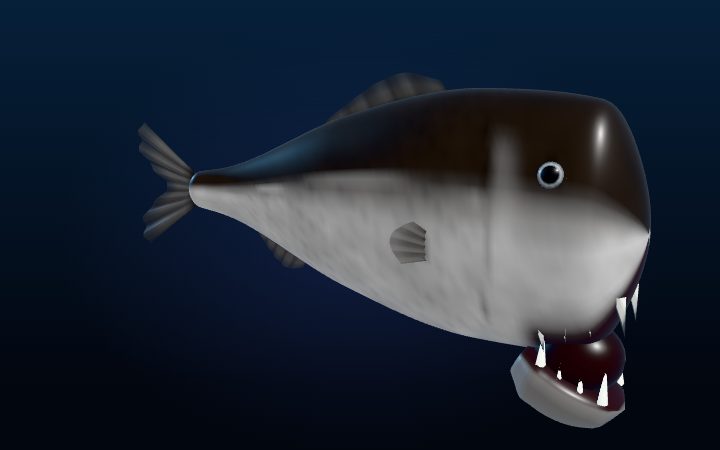
A short, deep body with a big head making up a third of its length, long fangs rising up and down, small eyes, and a dark brown to black body
More about this creature
Where and how deep it lives
It is found worldwide in tropical to cold-temperate seas, roughly from 65°N to 46°S, and is also known from the Flemish Cap in the western Atlantic. Records reach about 5,000 m, but it is most common at 200–2,000 m, with juveniles in the upper part of that range. Some researchers suggest it may rise toward the surface in the evening to feed and return to depth by dawn.
Food and hunting
Juveniles mainly filter zooplankton and crustaceans, while adults go after fish and squid. They are thought to find prey by touch and chemical senses and can kill fish much larger than themselves. In turn they are eaten by ocean predators such as tunas, albacore, marlins and some sharks.
Body and adaptations
It has a small head with a big jaw and a dark brown to black body flattened from side to side. The eyes are fairly small and set high on the head. Its teeth are permanently fixed and never replaced. The fins are small and spineless, and the scales are thin plates embedded in the skin.
Juveniles look completely different: they are light grey, with long spines on the head and gill cover, large eyes, a working gas bladder, long slender gill rakers and small teeth that fold back. These differences once led scientists to place juveniles in a separate genus, Caulolepis.
Life cycle and behaviour
It does not appear to guard its eggs, and the larvae drift as plankton. Spawning has been reported from June to August. At about 8 cm juveniles begin taking on the adult form and descend deeper, and sources give the size at maturity as about 13–16 cm.
It may school, travel in small groups or live alone. It is tougher than many deep-sea fishes and has survived for months in aquariums despite very different conditions.
Humans and conservation
Valenciennes described it in 1833. Its family contains only this species and A. brachycera, which is less than half its size and known only from juveniles, and it has no close relatives. It has no fishery value, is harmless to people and is rated Least Concern on the IUCN Red List.
Sources & further reading
- Anoplogaster cornuta — FishBase www.fishbase.se
- Fangtooth — Wikipedia en.wikipedia.org