Blobfish
Scientific name: Psychrolutes marcidus
The Blobfish is a sea creature that lives near the seafloor at depths of about 600–1,200 m, growing to about 30 cm. In Abyss Dive you meet it at 1,150 m, in the Midnight Zone (Bathypelagic).
- Depth range
- about 600–1,200 m
- Max size
- about 30 cm
- Zone in this guide
- Midnight Zone 1,000–4,000 m
- Bioluminescence
- No
- Habitat
- Near the seafloor
- Depth in the 3D dive
- 1,150 m
What is it?
A fish that lives near the bottom of the continental slope off southeastern Australia. With little muscle and flesh a bit lighter than water (a gelatinous tissue), it hovers just above the seafloor without effort.
Did you know?
The droopy look that earned it the title of 'world's ugliest animal' is what decompression does to its body when it's hauled up. At its normal depth it looks much more like an ordinary fish.
What it looks like
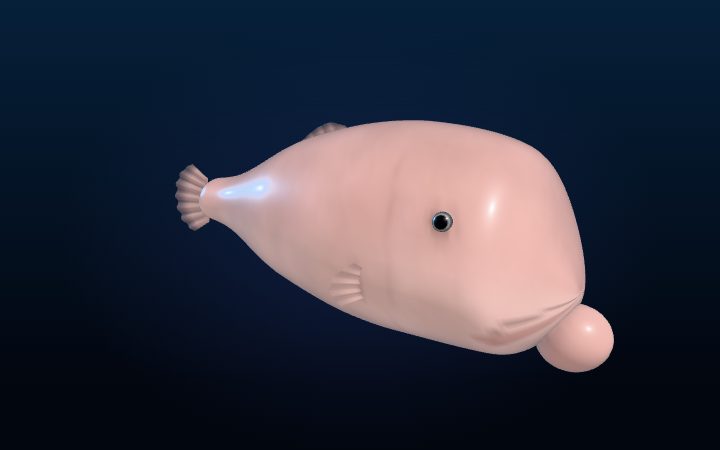
A tadpole-like shape with a big head and a short, tapering body, pale pink gelatinous skin, small eyes, a wide mouth, and small pectoral fins (not drooping at its home depth)
More about this creature
Where and how deep it lives
FishBase treats it as endemic to Australia, ranging from off Broken Bay, New South Wales (about 33.6°S), to southern Australia including Tasmania; other sources also include waters around New Zealand. It lives on the continental slope at about 600–1,200 m, where the pressure is roughly 60 to 120 times that at sea level.
Food and hunting
Rather than chasing prey, it hovers above the bottom and eats whatever drifts its way. Marine snow and deep-sea crustaceans are its main reported foods, and brittle stars, sea anemones and carrion have also been listed. Waiting instead of hunting saves energy where food is scarce. Its trophic level, estimated from close relatives, is about 3.4.
Body and adaptations
It has no swim bladder, which is thought to be because a gas-filled bladder would work poorly for buoyancy at such pressures. It also lacks strong bones and thick muscle; its body is rich in water and fat and covered in loose, scaleless skin.
At home in the deep it looks like a tadpole-shaped fish with large jaws and feathery pectoral fins. Most of what is known about it comes from dead specimens already damaged on the way up.
Life cycle and behaviour
It is known to lay eggs and is thought to guard its nests. National Geographic describes group breeding, nests of around 100,000 eggs and a parent that stays nearby, but even Australian Museum researchers only say they 'think' blobfish guard their nests, and reproduction remains poorly studied. It has no known predators, and its lifespan is unknown.
Humans and conservation
McCulloch first described it in 1926 as Neophrynichthys marcidus; it was later moved to Psychrolutes. It became famous through the 'Mr Blobby' photo taken by Dr Kerryn Parkinson in 2003 on the NORFANZ expedition, which surveyed deep habitats between Australia and New Zealand, although the Australian Museum has identified that specimen as the New Zealand endemic P. microporos. The fish is still preserved in a jar in the museum's ichthyology collection.
In 2013 it was voted the world's ugliest animal by the UK's Ugly Animal Preservation Society and became the society's mascot. It has not been assessed by the IUCN and there are too few data to judge its status; the popular idea that it is endangered is unsubstantiated. Deep-sea fishing such as bottom trawling, and warming seas, are cited as threats.
Sources & further reading
- Psychrolutes marcidus — FishBase www.fishbase.se
- Psychrolutes marcidus — Wikipedia en.wikipedia.org
- Blobfish — National Geographic www.nationalgeographic.com
- AM's ichthyologist & Mr Blobby — Council of Australasian Museum Directors camd.org.au