Dumbo octopus
Scientific name: Grimpoteuthis sp.
The Dumbo octopus is a sea creature that lives in open water at depths of about 1,000–7,000 m, growing to about 30 cm. In Abyss Dive you meet it at 3,200 m, in the Midnight Zone (Bathypelagic).
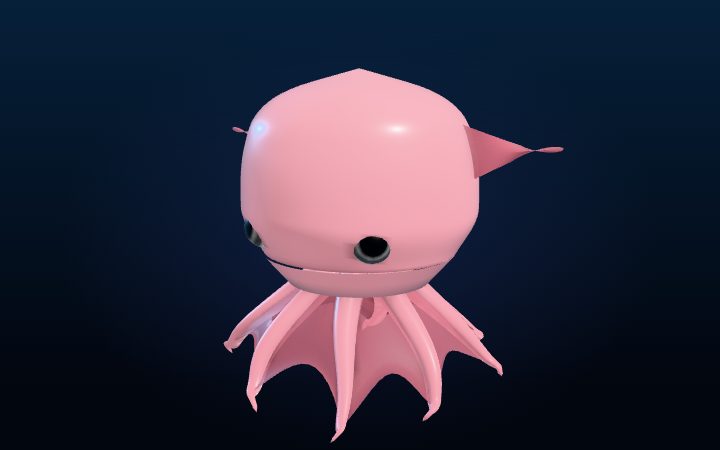
- Depth range
- about 1,000–7,000 m
- Max size
- about 30 cm
- Zone in this guide
- Midnight Zone 1,000–4,000 m
- Bioluminescence
- No
- Habitat
- Open water (swimming)
- Depth in the 3D dive
- 3,200 m
What is it?
A deep-sea octopus that swims by flapping the ear-like fins on either side of its head. It's named after Dumbo, the big-eared cartoon baby elephant.
Did you know?
The deepest-living group of octopuses, observed at about 6,957 m in the Java Trench in the Indian Ocean in 2020. It wraps prey in the web between its arms, then pushes it into its mouth with finger-like projections.
What it looks like
A round, bell-shaped, translucent pink body, a pair of large ear-like fins on either side of the head, and an umbrella-like web joining eight short arms (with rows of fine projections on the inner side of the arms)
More about this creature
Where and how deep it lives
Dumbo octopuses live mainly in cold water at about 1,000–7,000 m and are thought to occur worldwide. They have been recorded off Oregon, California, the Philippines, New Zealand and the Azores and in the Gulf of Mexico, and newer sightings include Norway (2022, about 1,250 m), Guyana (2023, about 2,108 m) and the Gulf of Guinea off Ivory Coast (2025, about 960 m). One specimen was reportedly caught off Grand Cayman at about 7,279 m, though that depth is uncertain. Different species may occupy different depths.
Food and hunting
Feeding has never been watched directly. Stomachs of dissected animals contained bottom-living bristle worms, copepods, amphipods and isopods. London's Natural History Museum describes them not as agile hunters but as animals that scrape up small prey around 1–2 mm in size.
Body and adaptations
The body is gelatinous and semi-translucent, and cushion-like cartilage at the base of each fin supports thick swimming muscles. The arms are joined by a web and carry about 65–68 suckers each, flanked by hair-like cirri. With no ink sac and no nerve-controlled colour cells, they cannot change colour. Most are about 20–30 cm long, but the largest on record was about 1.8 m and 5.9 kg.
Life cycle and behaviour
They often rest on the bottom with arms and web spread, or crawl slowly, and being close to neutrally buoyant they can drift with little effort. When disturbed they contract the web and arms to lift off, then swim quickly with their fins; jet propulsion is considered unlikely.
They seem to spawn continuously rather than in a season: females carry eggs at many stages and lay them one or two at a time. Males hand over sperm packets, which females store until eggs are ready. The tough-shelled eggs are attached to corals or rock and left unguarded, and the hatchlings can fend for themselves from the start. Lifespan is estimated at about 3–5 years.
Humans and conservation
The first specimens were collected on the British Challenger expedition of 1872–1876, but the genus was only named in 1932, by former Natural History Museum curator Guy Robson. About 17 species are recognized, though poorly preserved specimens keep the taxonomy muddled, and new species such as G. imperator and G. feitiana were still being described in 2021–2025. Many recent records come from remotely operated vehicles working from drilling platforms and survey ships.
Living mostly below 1,000 m, they face few direct human threats, but there is too little data to assess their conservation status. The Natural History Museum lists deep-sea mining near the seabed, microplastics and ocean acidification as concerns.
Sources & further reading
- Grimpoteuthis — Wikipedia en.wikipedia.org
- What is a dumbo octopus? — Natural History Museum, London www.nhm.ac.uk
- Dumbo Octopus — NOAA Ocean Today oceantoday.noaa.gov