Deep-sea shrimp
Scientific name: Acanthephyra purpurea
The Deep-sea shrimp is a bioluminescent (light-making) sea creature that lives in open water at depths of about 300–3,300 m, growing to about 12 cm. In Abyss Dive you meet it at 1,250 m, in the Midnight Zone (Bathypelagic).
- Depth range
- about 300–3,300 m
- Max size
- about 12 cm
- Zone in this guide
- Midnight Zone 1,000–4,000 m
- Bioluminescence
- Yes
- Habitat
- Open water (swimming)
- Depth in the 3D dive
- 1,250 m
What is it?
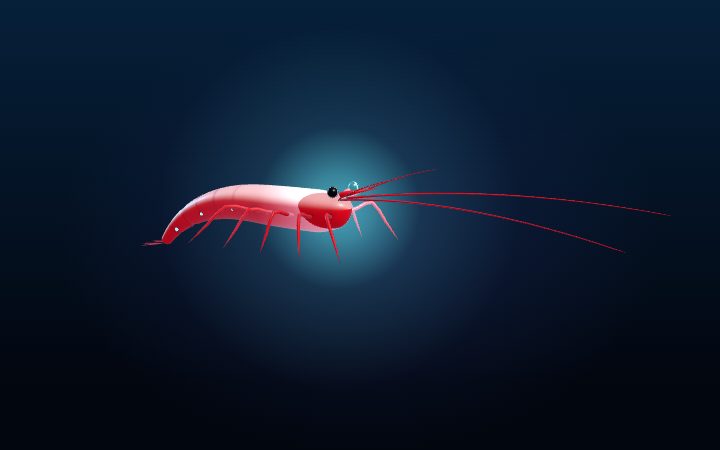
A bright red deep-sea shrimp. Red light doesn't reach these depths, so a red body looks black in the dark, which makes for excellent camouflage.
Did you know?
When threatened, it spews a big cloud of glowing fluid to fool the predator's eyes and escape.
What it looks like
A bright red, shrimp-like body, a long serrated rostrum, antennae longer than the body, thin legs, and a cloud of blue light erupting near the mouth when threatened
More about this creature
Where and how deep it lives
SeaLifeBase lists it from the western Atlantic and Arctic, including the Bahamas, the USA and Canada, at depths of about 300–3,292 m, though its distribution map is computer-generated and unreviewed.
It is a strong daily migrator. In Gulf of Mexico surveys in 2011 and 2015–2017 it stayed mostly below 600 m by day, while about 90% of the animals caught at night had risen into the top 600 m. Migration behaviour did not differ between the two survey periods.
Food and hunting
It is carnivorous. Earlier studies concluded that it feeds mainly at night, because animals caught in shallow water after dark had fuller or less-digested stomachs; there are hints that it also feeds at depth by day, but they are not conclusive.
A 2021 Gulf of Mexico study found that shrimp which had migrated upward were significantly more likely to have empty stomachs than those that stayed deep. That supports the hunger-satiation idea, in which animals that are already partly full may skip the nightly climb, although the authors saw stomach fullness as only one of several factors driving migration.
Body and adaptations
The glowing cloud it spews when threatened is not vomited stomach contents; it probably comes from the hepatopancreas, an organ that does some of the work of a liver and pancreas. The fluid does not glow inside the shrimp, but once released into seawater its luciferin reacts with oxygen, helped by the enzyme luciferase, to give off blue light.
Its luciferin differs structurally from those of bacteria, fishes and squid, and since its relative Systellaspis is known to make these compounds itself, the shrimp probably produces its own. Blue light travels farthest through seawater, which is why most glowing deep-sea animals use it. Other deep-sea shrimps such as Heterocarpus, Systellaspis and Oplophorus squirt similar luminous clouds.
Humans and conservation
Alphonse Milne-Edwards described it in 1881, and four names later given to the same animal are now treated as synonyms. Its glowing spew has earned it the nickname 'fire-breathing shrimp'. It is not fished, has not been assessed by the IUCN, and species-specific data on its size and breeding are scarce.
Sources & further reading
- Acanthephyra purpurea — SeaLifeBase www.sealifebase.se
- Acanthephyra purpurea — Wikipedia en.wikipedia.org
- Bos et al. (2021) Hunger-satiation and vertical migration of deep-pelagic crustaceans, Gulf of Mexico — Frontiers in Marine Science www.frontiersin.org
- Glow, Little Spewing Shrimp, Glow — National Geographic www.nationalgeographic.com