Harp sponge
Scientific name: Chondrocladia lyra
The Harp sponge is a sea creature that lives near the seafloor at depths of about 3,000–5,000 m, growing to about 60 cm. In Abyss Dive you meet it at 3,350 m, in the Midnight Zone (Bathypelagic).
- Depth range
- about 3,000–5,000 m
- Max size
- about 60 cm
- Zone in this guide
- Midnight Zone 1,000–4,000 m
- Bioluminescence
- No
- Habitat
- Near the seafloor
- Depth in the 3D dive
- 3,350 m
What is it?
A sponge discovered in 2012 by the Monterey Bay Aquarium Research Institute (MBARI) at about 3,300 m off northern California. It lives with its harp-shaped branches spread against the current.
Did you know?
Unlike ordinary sponges that filter water, it's carnivorous. Velcro-like hooks on the branch surfaces catch small crustaceans, which it then wraps up and digests.
What it looks like
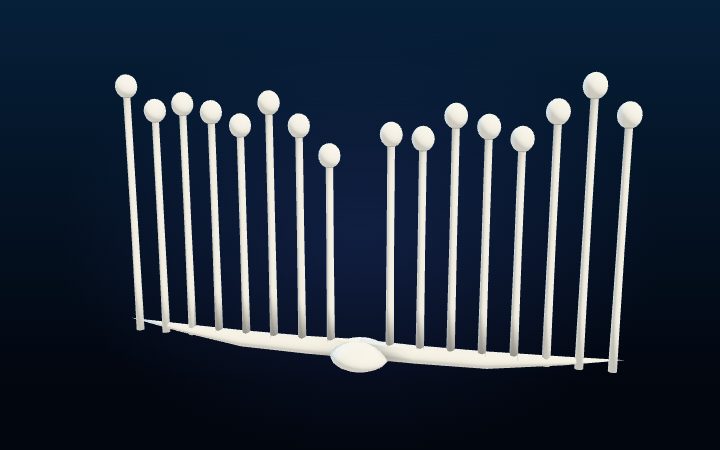
Several horizontal stems rooted in the bottom (radiating in 2–6 directions), with vertical branches standing in parallel like harp strings, a round, ball-like swelling at the tip of each branch, and a white color
More about this creature
Where and how deep it lives
It is known from Escanaba Ridge and Monterey Canyon off northern California. Specimens came from soft abyssal sediment at about 3,316–3,399 m; its full depth range is estimated at roughly 3,000–5,000 m, and it may span 1,600 km or more of latitude. It grows on slopes and canyon floors where prey is funnelled into crevices, a setting MBARI describes as extremely stable.
Food and hunting
When a copepod or other small crustacean snags on the hooks along its branches, the sponge wraps it in a digestive membrane, breaks it down and absorbs the nutrients through its pores. Constant filter-feeding costs a lot of energy where food is scarce, so catching larger, more nutritious prey is seen as a strategy suited to the deep sea. The harp-like frame itself probably evolved to maximize the area available for catching food.
Body and adaptations
It is anchored to the seafloor by a root-like rhizoid and does not move. One to six evenly spaced horizontal stolons radiate from the centre, and rows of vertical branches rise from each to form harp-like 'vanes'. Branches are longest in the middle of a vane and shorter towards its ends, and depending on the number of vanes the sponge is five-, four- or two-way symmetrical. Large specimens reach about 60 cm across and 40 cm tall.
Life cycle and behaviour
The tips of the vertical branches carry large round balls filled with sperm packets (spermatophores). When a released packet is caught on the filaments of another sponge, it fuses with that tissue, which swells as eggs form and mature there. The wide frame and filament-lined stolons help both to catch sperm and to spread it downstream.
Humans and conservation
It was found on an MBARI research voyage and described in 2012 in the journal Invertebrate Biology by Welton Lee, Henry Reiswig, William Austin and Lonny Lundsten. In 2013 Arizona State University's International Institute for Species Exploration picked it from more than 140 nominees as one of the Top 10 New Species. MBARI warns that deep-sea mining could disturb its remote habitat.
Sources & further reading
- Chondrocladia lyra — Wikipedia en.wikipedia.org
- Harp sponge — MBARI www.mbari.org