Giant phantom jelly
Scientific name: Stygiomedusa gigantea
The Giant phantom jelly is a sea creature that lives in open water at depths of about 80–6,665 m, growing to about 1 m. In Abyss Dive you meet it at 1,450 m, in the Midnight Zone (Bathypelagic).
- Depth range
- about 80–6,665 m
- Max size
- about 1 m
- Zone in this guide
- Midnight Zone 1,000–4,000 m
- Bioluminescence
- No
- Habitat
- Open water (swimming)
- Depth in the 3D dive
- 1,450 m
What is it?
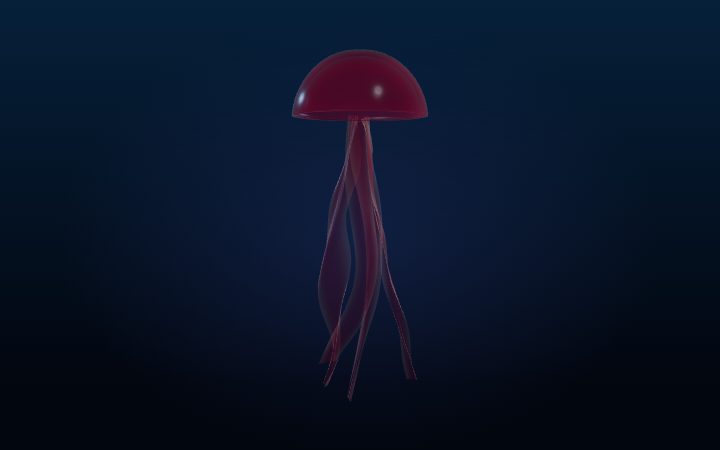
A giant jellyfish with a bell about 1 m across and four ribbon-like oral arms that trail up to about 10 m. In more than 110 years, only about 118 sightings have been recorded, so meeting one is rare.
Did you know?
A fish (Thalassobathia pelagica) lives alongside this jelly, apparently getting food and shelter and in return picking off its parasites.
What it looks like
A dark red, bell-shaped umbrella about 1 m across, four broad ribbon- or kite-shaped oral arms hanging below (up to 10 times the bell's width in length), and no fine tentacles
More about this creature
Where and how deep it lives
It has been recorded in every ocean basin except the Arctic, so it is effectively worldwide. It usually lives in the mesopelagic and bathypelagic zones, but at high latitudes in the Southern Ocean it comes much shallower, and Antarctic sightings have been made at about 80–280 m.
In November 2021 MBARI's remotely operated vehicle Doc Ricketts filmed one at about 990 m in Monterey Bay. Many Antarctic sightings come from submersibles on tourist expeditions, including a photo taken near the Melchior Islands in December 2023.
Food and hunting
It has no stinging tentacles, so it does not sting its prey. Instead it is thought to trap food with its broad oral arms, feeding on plankton and small fishes.
Body and adaptations
Its four oral arms are broad, like paddles or kites. The bell looks red-orange only under visible light, and its spongy, jelly-like tissue lets it withstand pressures of about 40 MPa.
Life cycle and behaviour
Because sightings are so rare, its reproduction is poorly documented. It has been reported to be viviparous, with young developing in brood chambers inside the parent, and young specimens that have been caught looked like miniature adults.
Its partnership with the fish Thalassobathia pelagica was confirmed by MBARI video from the Gulf of California, the first documented symbiosis for a fish of the order Ophidiiformes. The fish can find its way back to the jelly after being separated, perhaps by sensing low-frequency water movements with its lateral line.
Humans and conservation
The first specimen, collected in 1899, weighed about 40 kg. Browne described it in 1910 as Diplulmaris (?) gigantea, but it was recognised as a distinct genus only in 1959, when Russell erected Stygiomedusa.
Nets tear these jellies apart, so they are now studied intact with ROV cameras. Even MBARI, after more than 34 years of deep-sea research in Monterey Bay, has seen the species only nine times.
Sources & further reading
- Stygiomedusa — Wikipedia en.wikipedia.org
- Chance observations go viral — MBARI 2021 Annual Report annualreport.mbari.org