Yeti crab
Scientific name: Kiwa hirsuta
The Yeti crab is a sea creature that lives near the seafloor at depths of about 2,000–2,500 m, growing to about 15 cm. In Abyss Dive you meet it at 2,250 m, in the Midnight Zone (Bathypelagic).
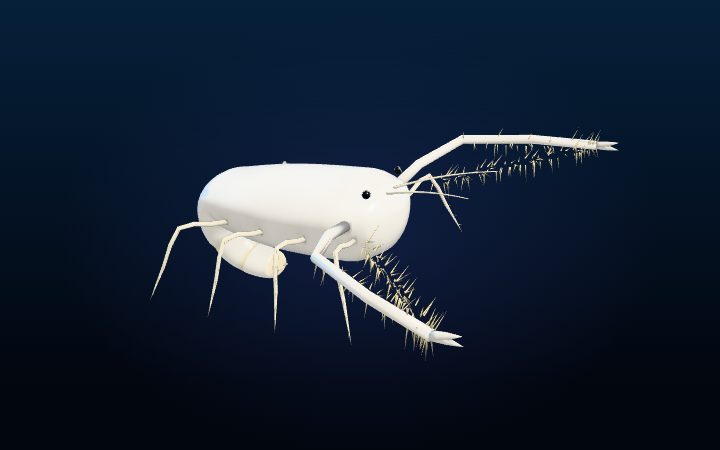
- Depth range
- about 2,000–2,500 m
- Max size
- about 15 cm
- Zone in this guide
- Midnight Zone 1,000–4,000 m
- Bioluminescence
- No
- Habitat
- Near the seafloor
- Depth in the 3D dive
- 2,250 m
What is it?
A crab discovered in 2005 at about 2,200 m near hydrothermal vents south of Easter Island in the South Pacific. Its claws are covered with golden, hair-like bristles.
Did you know?
It's thought to farm bacteria in its hairs and eat them. A close relative has been seen doing this, harvesting the bacteria with the bristles near its mouth.
What it looks like
A white oval body, claws longer than the body thickly covered in golden hair-like bristles, and nearly degenerate eyes
More about this creature
Where and how deep it lives
It is known from hydrothermal vents on the Pacific-Antarctic Ridge, about 1,500 km south of Easter Island. Most were found on fresh lava flows and in spots where warm water seeps out of the seafloor, and many were tucked under or behind rocks with only the tips of their claws showing.
Food and hunting
Dense colonies of filamentous bacteria grow on the bristles covering its legs and claws, and these bacteria are thought to be its main food. The bacteria may also help detoxify minerals in the vent water. Yet the crabs were also seen eating mussels cracked open when the submersible Alvin landed, so they apparently take other food when it is available.
Body and adaptations
At about 15 cm long it is large for its kind. Its eyes are strongly reduced and unpigmented, and it is thought to be blind. MBARI notes that the flexible, hair-like setae may do more than host bacteria, possibly working as chemical and touch sensors for finding food or mates.
Life cycle and behaviour
Researchers saw the crabs holding their hairy claws out over plumes of warm vent water. Females carry their eggs attached to bristles under the abdomen and tend them until the larvae hatch. Basic facts such as lifespan and growth rate remain almost unknown.
Humans and conservation
It was first seen in March 2005 from the submersible Alvin during MBARI's Easter Microplate expedition led by Robert Vrijenhoek, which was studying how vent animals colonize distant vents; the find was announced in March 2006. French-led taxonomists (Macpherson, Jones and Segonzac) described it not only as a new species but as a new family, Kiwaidae.
Despite the name 'crab', it is a squat lobster, more closely related to true crabs and hermit crabs than to true lobsters. The genus name comes from a Polynesian shellfish deity and hirsuta is Latin for 'hairy'. It has not been assessed by the IUCN, and deep-sea mining around vents is mentioned as a potential threat.
Sources & further reading
- Kiwa hirsuta — Wikipedia en.wikipedia.org
- Discovery of yeti crab — MBARI www.mbari.org