Swimming sea cucumber
Scientific name: Enypniastes eximia
The Swimming sea cucumber is a bioluminescent (light-making) sea creature that lives in open water at depths of about 500–5,700 m, growing to about 25 cm. In Abyss Dive you meet it at 2,800 m, in the Midnight Zone (Bathypelagic).
- Depth range
- about 500–5,700 m
- Max size
- about 25 cm
- Zone in this guide
- Midnight Zone 1,000–4,000 m
- Bioluminescence
- Yes
- Habitat
- Open water (swimming)
- Depth in the 3D dive
- 2,800 m
What is it?
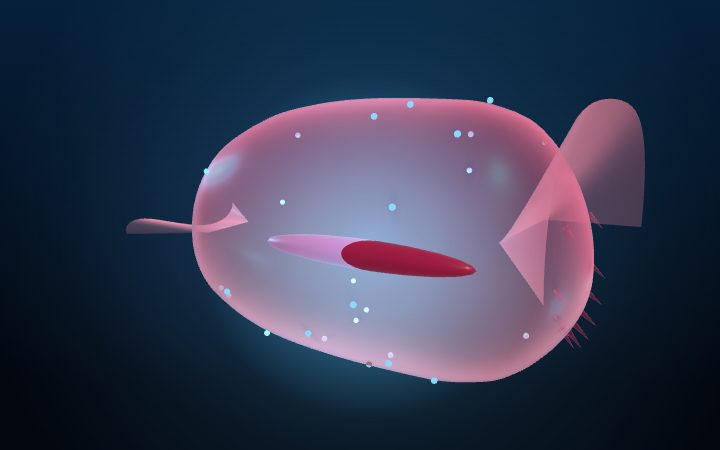
A sea cucumber with a translucent pink body through which its gut can be seen. It feeds on seafloor mud, then lifts off and swims by flapping webbed skin at the front and back. It settles on the bottom only to eat and spends most of its time in open water.
Did you know?
Its looks earned it the nickname 'headless chicken monster'. It can also make light.
What it looks like
A translucent pink-to-red oval body about 25 cm long (the gut shows through), a broad veil-like membrane at the front, a paddle-like web at the back, and short tentacles around the mouth
More about this creature
Where and how deep it lives
SeaLifeBase lists records from about 516 to 5,689 m in the Indian Ocean and western Atlantic, and it has been seen in many other oceans. In the deep Caribbean it is a prominent member of the community living just above the seafloor. In October 2018 a camera deployed by the Australian Antarctic Division off East Antarctica caught it on video, the first footage from the Southern Ocean.
After feeding it rises back into the water; in Robison's 1992 observations it usually returned to within about 50 m of the bottom. Other accounts say it can swim up to 1,000 m above the seafloor.
Food and hunting
Like most sea cucumbers it eats seafloor sediment, pushing it into its mouth with its tentacles. It stays on the bottom for no more than about 64 seconds at a time, so feeding happens in brief touch-downs between swims. Right after a meal the filled gut shows even more clearly through the translucent body.
Body and adaptations
It is about 11–25 cm long; small individuals are bright pink and larger ones reddish-brown. The body is round and bulbous, with branched tentacles and a large sail-like veil at the front. It rows with the front veil and, when there is a current, uses its tentacles to work its way along with the flow.
Life cycle and behaviour
Its light is triggered by touch and comes from hundreds of granular bodies in its gelatinous skin. A light touch makes a local glow that gradually spreads over the whole body; a hard knock makes the fragile skin slough off in a glowing cloud. In the lab the lost skin, and its ability to glow, regenerated quickly.
Robison interpreted this as a 'burglar alarm' strategy: a predator that grabs the animal lights itself up, revealing its position to larger, sight-hunting predators.
Humans and conservation
Théel described the species in 1882, and the genus name comes from the Koine Greek for 'dreamer'. Other nicknames include 'Spanish dancer' and 'pink see-through fantasia'. The 2018 Southern Ocean footage came from a camera built to clip onto commercial longlines; the project studied fishing impacts on deep-sea life and flagged sensitive seafloor to avoid, with results presented to the Commission for the Conservation of Antarctic Marine Living Resources (CCAMLR). It has not been evaluated by the IUCN.
Sources & further reading
- Enypniastes eximia — SeaLifeBase www.sealifebase.se
- Enypniastes — Wikipedia en.wikipedia.org
- Robison 1992, Bioluminescence in the benthopelagic holothurian Enypniastes eximia — Journal of the Marine Biological Association of the UK www.cambridge.org
- Rarely seen 'headless chicken monster' spotted in Southern Ocean — NBC News www.nbcnews.com