Giant tube worm
Scientific name: Riftia pachyptila
The Giant tube worm is a sea creature that lives near the seafloor at depths of about 1,800–3,000 m, growing to about 3 m. In Abyss Dive you meet it at 2,400 m, in the Midnight Zone (Bathypelagic).
- Depth range
- about 1,800–3,000 m
- Max size
- about 3 m
- Zone in this guide
- Midnight Zone 1,000–4,000 m
- Bioluminescence
- No
- Habitat
- Near the seafloor
- Depth in the 3D dive
- 2,400 m
What is it?
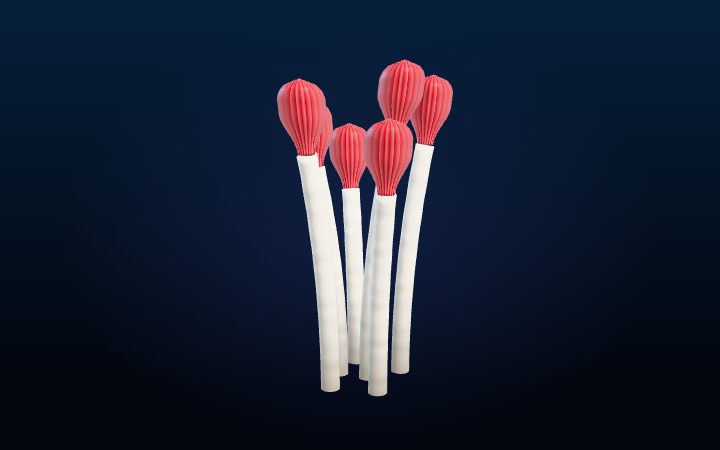
A worm that lives in clusters around hot vents on the seafloor, up to about 2–3 m long. The bright red plume sticking out of the white tube is red because of hemoglobin.
Did you know?
Adults have no mouth or gut. Symbiotic bacteria inside the body make nutrients from the vents' hydrogen sulfide. It can grow up to 1.5 m in under two years, making it the fastest-growing marine invertebrate.
What it looks like
White tubes (a few cm wide, up to 2–3 m long) rising in clumps from the bottom, each topped with a bright red feathery gill plume
More about this creature
Where and how deep it lives
It forms dense colonies around hydrothermal vents on the East Pacific Rise and the Galápagos Rift, and the patch around a single vent can span tens of metres. Surrounding water is roughly 2–30 °C, but the worms favour sites with heavy sulfide output and temperatures up to about 54 °C. Because it needs strong flow and high temperatures, it shares out space with other large vent animals: giant clams take the low-flow spots, while mussels settle around the edges or on the tubes themselves.
Food and hunting
The red, feathery plume absorbs oxygen, hydrogen sulfide and carbon dioxide from the water, and its hemoglobin carries both oxygen and sulfide to the trophosome, a bacteria-filled organ in the middle of the body. Unusually, this hemoglobin can carry oxygen even when sulfide is present. Nitrate is concentrated in the blood to about 100 times seawater levels, and the bacteria turn it into building blocks for amino acids.
Inside the trophosome, young bacteria divide to keep the population going while older, larger ones move to the edge, where the worm digests them. In 2024 a Harvard team reported in Nature Microbiology that these symbionts run two carbon-fixation pathways at once, the Calvin–Benson–Bassham cycle and the reverse TCA cycle, and fix carbon at exceptionally high rates.
Body and adaptations
From front to back the body has the plume, a muscular 'vestimentum' holding the heart, brain and two genital openings, the trophosome, and a rear section that anchors the worm in its tube. When threatened it pulls the plume inside and seals the opening with a stiff, collagen-based plug called the obturaculum. The tube is made of chitin, very thick at the base, and resists enzymes so well that it can take years to decompose.
Life cycle and behaviour
Sexes are separate. Males release bundles of about 340–350 sperm that swim towards the female's tube. The larvae have a complete gut but no symbionts; they drift with bottom currents, have survived 38 days in culture, and are estimated to disperse 100–200 km.
Once a larva settles on an active vent it stays put for life, takes up bacteria from the surrounding water and remodels its gut into the trophosome. When the vent shuts down, the colony dies. Since most vents last less than ten years, claims that the worm lives for centuries are considered unlikely; it is related seep tubeworms that have age estimates over a century.
Humans and conservation
Scientists first encountered it in 1977, when a geological expedition led by Jack Corliss used the submersible Alvin to confirm vents on the Galápagos Rift. One densely packed site was nicknamed the 'Rose Garden', and M. L. Jones formally described the species in 1981. That same year Colleen Cavanaugh showed that chemosynthesis takes place in the trophosome, the first described partnership between a marine invertebrate and chemosynthetic bacteria.
By 1985 clams and mussels had displaced many of the Rose Garden's worms, and a 2002 expedition found the site buried by a lava flow. A new community nearby was named 'Rosebud'.