Sablefish
Scientific name: Anoplopoma fimbria
The Sablefish is a sea creature that lives in open water at depths of about 175–2,740 m, growing to about 1.2 m. In Abyss Dive you meet it at 1,350 m, in the Midnight Zone (Bathypelagic).
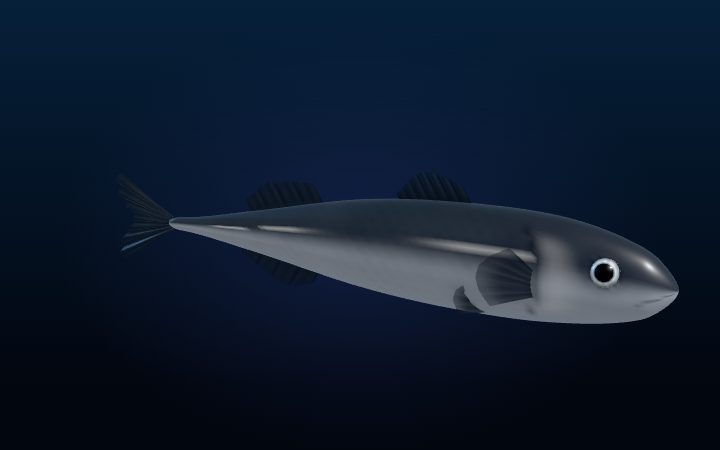
- Depth range
- about 175–2,740 m
- Max size
- about 1.2 m
- Zone in this guide
- Midnight Zone 1,000–4,000 m
- Bioluminescence
- No
- Habitat
- Open water (swimming)
- Depth in the 3D dive
- 1,350 m
What is it?
A dark gray fish that lives near the muddy bottom of the continental slope in the North Pacific, and reaches the dinner table as 'black cod'. The young grow up in shallower water and move deeper as adults.
Did you know?
It lives long: one individual was recorded at 94 years old.
What it looks like
A long, spindle-shaped blackish-gray body, two separate dorsal fins, a forked tail, and small scales
More about this creature
Where and how deep it lives
It lives across the North Pacific, from the Bering Sea coasts of Kamchatka and Alaska south to southern Japan in the west and to Cedros Island, Baja California, Mexico, in the east. It is usually caught at about 175–1,450 m, and NOAA describes adults as living on mud bottoms deeper than about 200 m.
Off North America there is a northern population in Alaska and northern British Columbia and a southern one further south, mixing off southwest Vancouver Island and northwest Washington. Sablefish are great travellers: tagged fish have moved thousands of kilometres, and one study found an average distance of about 602 km between release and recapture.
Food and hunting
An opportunistic predator, it eats fishes such as walleye pollock, eulachon, capelin, herring, sand lance and Pacific cod, along with squid, krill and jellyfish. FishBase lists crustaceans, worms and small fishes and puts its trophic level at about 3.8.
Body and adaptations
Its white, soft flesh is so oily that its omega-3 (EPA and DHA) content rivals that of wild salmon, and its liver oil is rich in vitamins A and D. Size varies by region: Alaskan fish grow largest, up to about 114 cm and 25 kg, but the average is under 70 cm and about 4 kg.
Life cycle and behaviour
Adults spawn deep on the continental slope, from January to April in Alaska and from January to March between California and British Columbia. The eggs develop in deep water for about two weeks, and the larvae then rise to the surface to be carried by currents. Young-of-the-year live near the surface and inshore, appearing in nearshore waters of southeast Alaska and British Columbia by autumn.
Females mature at about six and a half years and a little over 60 cm, males at about five. Although the species can live a very long time, most of the catch in many areas is under 20 years old.
Humans and conservation
It is caught by longline, pot and trawl; in Alaska fixed gear (longlines and pots) takes about 90% of the annual quota and trawls about 10%. Killer whales and sperm whales often strip fish from Alaskan longlines as they are hauled, which has pushed more fishers to use pots. NOAA has tagged sablefish in Alaska since 1972.
US commercial landings in 2024 were about 64 million pounds worth some 96 million dollars, and its rich flesh makes it one of the highest-value finfish per pound. Neither the Alaska stock (2024 assessment) nor the Pacific coast stock (2025 assessment) is overfished, and some fisheries carry MSC certification. Most of the catch is sold in Japan, where it is known as gindara and often marinated in miso or sake lees before grilling; in the United States farming is still experimental rather than commercial.
Sources & further reading
- Anoplopoma fimbria — FishBase www.fishbase.se
- Sablefish — Wikipedia en.wikipedia.org
- Sablefish — NOAA Fisheries www.fisheries.noaa.gov