Black dragonfish
Scientific name: Idiacanthus atlanticus
The Black dragonfish is a bioluminescent (light-making) sea creature that lives in open water at depths of about 0–2,000 m, growing to about 40 cm. In Abyss Dive you meet it at 1,280 m, in the Midnight Zone (Bathypelagic).
- Depth range
- about 0–2,000 m
- Max size
- about 40 cm
- Zone in this guide
- Midnight Zone 1,000–4,000 m
- Bioluminescence
- Yes
- Habitat
- Open water (swimming)
- Depth in the 3D dive
- 1,280 m
What is it?
Females are slim, black predators up to about 40 cm long, but males are only about 4 cm and have neither teeth nor a barbel. Females stay deeper than 500 m by day and come up near the surface at night, while males always stay below 1,000 m.
Did you know?
As larvae, their eyes sit at the ends of long stalks sticking out of the body; the stalks shrink as the fish grows until the eyes sit against the head.
What it looks like
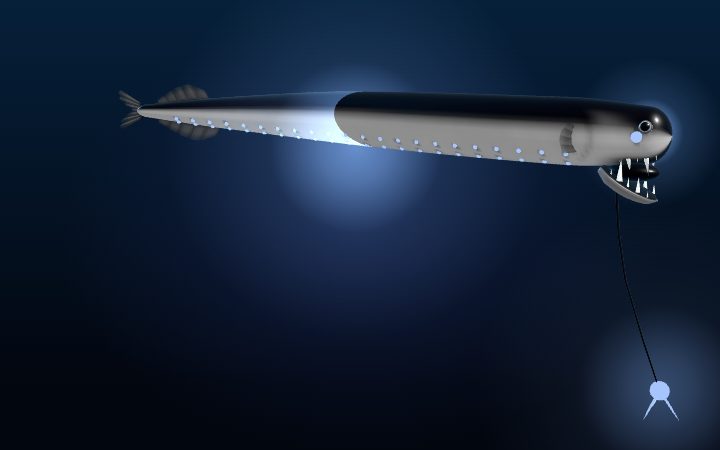
A slender, eel-like, jet-black body (female), a big mouth full of fangs, a long barbel under the chin with a light lure at its tip, a light organ behind the eye, and a row of light spots along the belly
More about this creature
Where and how deep it lives
It ranges right around the Southern Hemisphere in subtropical and temperate waters, roughly between 25°S and 60°S. The subtropical convergence probably sets its northern limit, and it occasionally turns up in sub-Antarctic waters. It is recorded down to about 2,000 m; one was collected at about 1,000 m on the NORFANZ expedition between Australia and New Zealand in May 2003.
Food and hunting
Stomach-content data are lacking even in FishBase. Its trophic level, estimated from the size and diet of close relatives, is about 4.0, which places it among predators of other animals.
Body and adaptations
Females are black, with well-developed canine teeth, a chin barbel and pelvic fins of six rays. Males are dark brown and lack not only the upper-jaw teeth and barbel but also the pelvic fins.
The light it produces is close to infrared and barely visible to people. Most predators that make such light cannot see it themselves, but this fish can, and it is known to use the light to hunt.
Life cycle and behaviour
Larvae are long, slender and transparent, with eye stalks up to half the length of the body. The Australian Museum explains the stalks with the idea that young fish die mainly from starvation and predation, so vision for finding food and spotting enemies matters; stalked eyes widen the volume of water a larva can scan. Along the sequence from round, flat-set eyes to short and then long stalks, this species sits at the extreme. Almost nothing is known about its spawning season, eggs or lifespan.
Humans and conservation
Brauer described it in 1906, and the fossil record goes back to the Miocene. It has no fishery value, and the IUCN Red List rates it Least Concern. FishBase rates its resilience as low, with a population doubling time of about 4.5–14 years.
Sources & further reading
- Idiacanthus atlanticus — Wikipedia en.wikipedia.org
- Idiacanthus atlanticus — FishBase www.fishbase.se
- Eyes of larval Black Dragonfish — Australian Museum australian.museum