Sloane's viperfish
Scientific name: Chauliodus sloani
The Sloane's viperfish is a bioluminescent (light-making) sea creature that lives in open water at depths of about 200–4,700 m, growing to about 35 cm. In Abyss Dive you meet it at 1,050 m, in the Midnight Zone (Bathypelagic).
- Depth range
- about 200–4,700 m
- Max size
- about 35 cm
- Zone in this guide
- Midnight Zone 1,000–4,000 m
- Bioluminescence
- Yes
- Habitat
- Open water (swimming)
- Depth in the 3D dive
- 1,050 m
What is it?
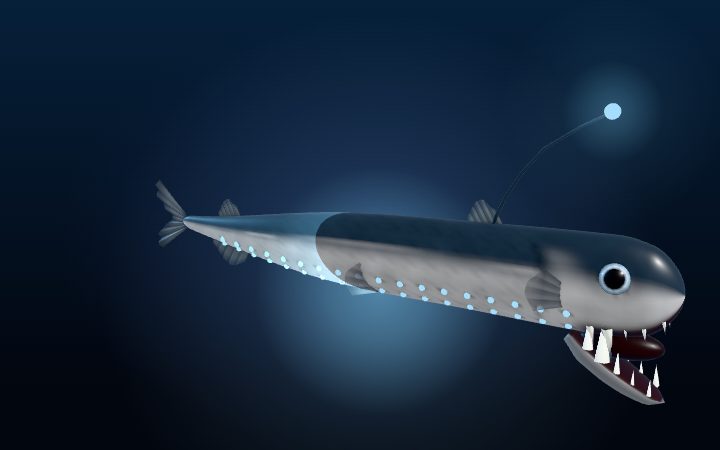
A deep-sea predator with long, needle-like fangs and a glowing lure at the tip of its dorsal fin. Rows of light organs along its underside help draw in prey. It mostly lives at about 500–1,000 m and sometimes rises to shallower water at night.
Did you know?
Its fangs are so long that they don't fit inside the mouth even when it's closed, and poke out in front of the head.
What it looks like
A long, slender, dark blue-black body, needle-like fangs poking out of the mouth, a long first dorsal-fin ray with a light lure at its tip, and rows of light organs along the belly
More about this creature
Where and how deep it lives
It is widespread in warm and temperate parts of the Atlantic, Indian and Pacific oceans and also lives in the western Mediterranean and the South and East China Seas. There are gaps in the southern central Atlantic, the northern Indian Ocean and the eastern Pacific north of the equator. Records span roughly 70°N to 56°S.
The full recorded depth range is about 200–4,700 m, and it varies a lot by region: in the eastern Ionian Sea, for example, it was caught at about 473–1,192 m. Water temperature is known to limit how deep or shallow it lives.
Food and hunting
Lanternfishes are its most important food. In one study, 18 of the 28 fish species found as prey were lanternfishes, and it was estimated to eat at least one every twelve days. Crustaceans turned up only in individuals shorter than about 120 mm.
It feeds rarely and opportunistically, with no daily feeding rhythm observed, and a single meal can weigh up to half its own body weight. Eggs and algae have also been found in its stomach.
Body and adaptations
Its jaws open to about 90 degrees to take large prey. The teeth are fixed to the jawbone and cannot fold back, so a closed mouth forms a cage; the front tooth wounds larger prey while the curved second tooth holds it like a dagger. An extra jaw-closing muscle probably adds bite force.
The body is wrapped in a thick, transparent gelatinous layer, its scales and tail skeleton are poorly ossified, and it has no gas-filled swim bladder. Fat makes up only about 2.4% of its body weight. It can adjust the brightness of its light organs, probably to hide from predators below, and both adrenaline and noradrenaline are involved in producing the light.
Life cycle and behaviour
It lays eggs. Females mature at about 133–191 mm and males probably at slightly smaller sizes; growth, lifespan and breeding behaviour are almost unknown. FishBase rates its resilience as medium, with a population doubling time of about 1.4–4.4 years.
Humans and conservation
Bloch and Schneider described it in 1801. The genus Chauliodus contains nine other species, and this one is set apart by its circumglobal range. It is not fished commercially but turns up as bycatch, and it is harmless to people. The IUCN Red List rates it Least Concern.
Sources & further reading
- Chauliodus sloani — FishBase www.fishbase.se
- Sloane's viperfish — Wikipedia en.wikipedia.org