Helmet jellyfish
Scientific name: Periphylla periphylla
The Helmet jellyfish is a bioluminescent (light-making) sea creature that lives in open water at depths of about 250–2,700 m, growing to about 30 cm. In Abyss Dive you meet it at 1,600 m, in the Midnight Zone (Bathypelagic).
- Depth range
- about 250–2,700 m
- Max size
- about 30 cm
- Zone in this guide
- Midnight Zone 1,000–4,000 m
- Bioluminescence
- Yes
- Habitat
- Open water (swimming)
- Depth in the 3D dive
- 1,600 m
What is it?
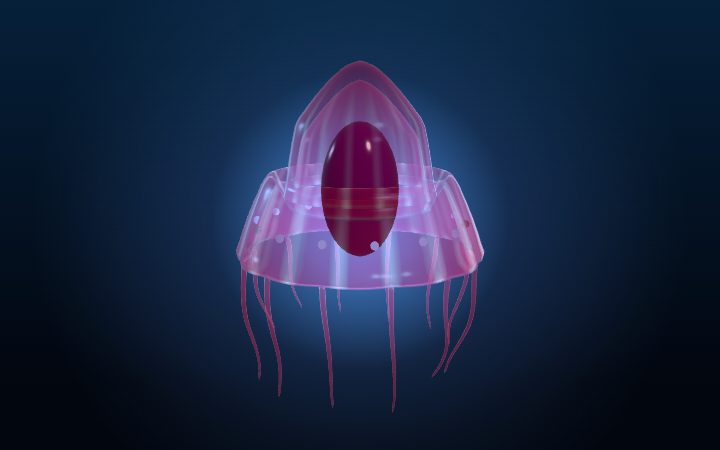
A red jellyfish with a tall, pointed, cone-shaped bell like a helmet. It hates light, and avoids it using small sense organs that tell brightness.
Did you know?
It makes its own light, which seems to be used for signaling between individuals.
What it looks like
A tall, cone- or helmet-shaped bell (with a deep groove beneath), translucent red outside and deep purple inside, with twelve thick, stiff tentacles around the rim
More about this creature
Where and how deep it lives
It lives in nearly every ocean except the Arctic, and in the Mediterranean, and is far more abundant in some Norwegian fjords than elsewhere. It also occurs in the Iceland and Greenland seas and has become more common in the northern Barents Sea in recent years. Most specimens are collected at about 4–11 °C, though it tolerates water near 20 °C.
It is recorded down to about 2,700 m; north of 42°N it also lives in shallow water, but in the subtropics and tropics it stays deeper. It migrates daily, deeper by day and shallower at night, possibly following krill, usually moving vertically at less than 2 cm per second.
Food and hunting
A 2017 gut-content study found an average of five prey species per jelly, made up of copepods (27%), pteropods (23%), amphipods (20%), krill (17%) and arrow worms (13%). It also eats northern krill (Meganyctiphanes norvegica) and ostracods, and occasionally small fishes and other jellies.
Muscles in the tentacles sweep prey quickly toward the mouth with a corkscrew-like capture motion, and the lappets around the bell margin fold the food in.
Body and adaptations
Twelve stiff tentacles ring its thick, bell-shaped umbrella. The bell grows to about 30–35 cm across, and roughly 96% of the body weight is water. The red-brown colour comes from a pigment called protoporphyrin, and in the final developmental stage purple pigment appears in the mouth and stomach.
Sunlight is harmful and can be fatal to it, so it avoids brightly lit depths. Relatively high levels of the enzyme lactate dehydrogenase suit it to low-oxygen layers, and it glows blue or blue-green at every life stage, lighting up when touched.
Life cycle and behaviour
It develops straight from egg to medusa, with no polyp, planula or ephyra stage, and spends its whole life drifting in open water. It is the only scyphozoan known to reproduce sexually without a planula stage. Its eggs are the largest of any cnidarian, and although a female's gonads hold thousands of them, she releases relatively few over a long period.
It breeds year-round, and growing through the first nine developmental stages takes about two to three months. Its lifespan is poorly known but appears long for a jelly: Animal Diversity Web gives about 30 years in the wild, possibly several decades.
Humans and conservation
Péron and Lesueur first described it in 1810. In Norwegian fjords its huge swarms clog fishing nets and have hurt local fisheries. Below 1,000 m in the North Atlantic, its main predators are Baird's slickhead (Alepocephalus bairdii) and the roundnose grenadier (Coryphaenoides rupestris).
In November 2025 a seven-arm octopus was filmed at about 700 m in Monterey Bay clutching a helmet jelly. Amphipods of the genus Hyperia live on or in the jelly, though whether they are parasites is unknown. It has not been assessed by the IUCN.
Sources & further reading
- Periphylla periphylla — Wikipedia en.wikipedia.org
- Periphylla periphylla — Animal Diversity Web animaldiversity.org
- MBARI researchers encounter rarely seen deep-sea seven-arm octopus — MBARI www.mbari.org