Brownsnout spookfish
Scientific name: Dolichopteryx longipes
The Brownsnout spookfish is a sea creature that lives in open water at depths of about 500–2,400 m, growing to about 18 cm. In Abyss Dive you meet it at 1,400 m, in the Midnight Zone (Bathypelagic).
- Depth range
- about 500–2,400 m
- Max size
- about 18 cm
- Zone in this guide
- Midnight Zone 1,000–4,000 m
- Bioluminescence
- No
- Habitat
- Open water (swimming)
- Depth in the 3D dive
- 1,400 m
What is it?
A deep-sea fish with a delicate body and tubular eyes pointing upward. Each eye has a separate side chamber that looks downward, so it sees above and below at the same time.
Did you know?
One of the few vertebrates known to form images with mirrors as well as a lens. In the side chamber, stacked crystal plates form a curved mirror that gathers light from below.
What it looks like
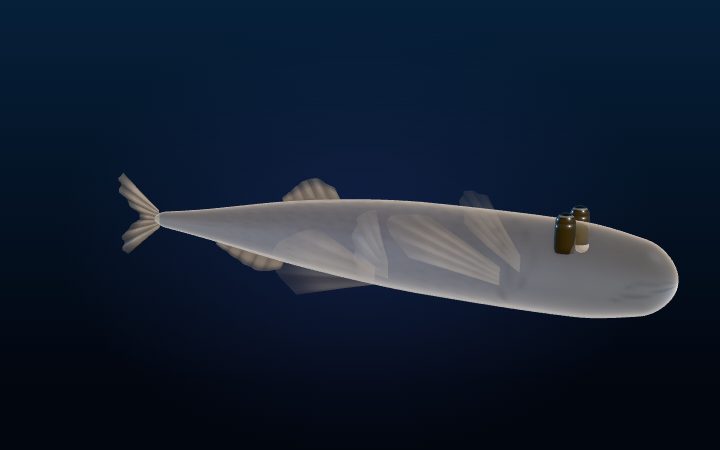
A slender, translucent light-brown body, two tubular eyes rising from the head (with a small blob-like mirror chamber beside each, looking down), and long, trailing pectoral and pelvic fins
More about this creature
Where and how deep it lives
It probably occurs worldwide in tropical and temperate seas. Atlantic records come from Bermuda, the Bahamas, the Greater Antilles and the Gulf of Mexico, and Pacific ones from the California Current region and the South China Sea. It lives at about 500–2,400 m, usually below 1,000 m, although in the Gulf of Mexico it has been caught at about 310–460 m.
Food and hunting
It feeds mainly on copepods and other small crustaceans, and in the food-poor deep sea it probably eats whatever it can catch.
Body and adaptations
The body is slender, its depth only about 13–14% of standard length, with a long pointed snout and no teeth in the upper jaw. The transparent body is covered in thin scales, though adults keep only traces of scales and pigment, and the pelvic fins are greatly elongated.
The upward-facing tubular eye uses a lens and probably picks out silhouettes against faint sunlight, while the downward-looking side chamber likely catches bioluminescent flashes from the sides and below. In other deep-sea fishes such side eyes lack a lens and give only a blurred image, but this fish's mirror sits in front of the retina and focuses light, giving a brighter image than a lens could. A silvery layer, the argentea, covers the eyes for camouflage.
Life cycle and behaviour
Eggs and larvae drift in open water; the tail fin forms at about 13 mm and metamorphosis happens at about 30 mm. Larva-like juveniles and adults are wrapped in a gelatinous sheath, and adults keep juvenile traits such as weak muscles and fins. Developed gonads have been seen in a 36 mm male and a 40 mm female, and its lifespan is reported as about five years.
Humans and conservation
Vaillant first described it in 1888 as Aulostoma longipes. For 120 years the only specimens were dead and badly damaged, until an expedition on the German research vessel Sonne, led by Hans-Joachim Wagner of the University of Tübingen, caught the first live one at about 700 m over the Tonga Trench off Samoa. The team used a net with an insulated collecting chamber that closes at depth.
A computer simulation by Julian Partridge of the University of Bristol showed that the arrangement of the mirror's plates is well suited to focusing light onto the retina, and the work was published in Current Biology in January 2009. The IUCN Red List rates it Least Concern (2015 assessment).