Bone-eating worm
Scientific name: Osedax rubiplumus
The Bone-eating worm is a sea creature that lives near the seafloor at depths of about 2,800–3,000 m, growing to about 7 cm. In Abyss Dive you meet it at 2,890 m, in the Midnight Zone (Bathypelagic).
- Depth range
- about 2,800–3,000 m
- Max size
- about 7 cm
- Zone in this guide
- Midnight Zone 1,000–4,000 m
- Bioluminescence
- No
- Habitat
- Near the seafloor
- Depth in the 3D dive
- 2,890 m
What is it?
A worm first found in 2002 on the carcass of a gray whale lying on the seafloor at about 2,893 m in Monterey Bay, USA. With no mouth or gut, it lives with root-like tissue sunk into the whale bones.
Did you know?
The roots release acid that dissolves bone, and symbiotic bacteria in its body break down the fat and protein inside. Males, visible only under a microscope, live inside the female's tube, 50 to 100 of them together.
What it looks like
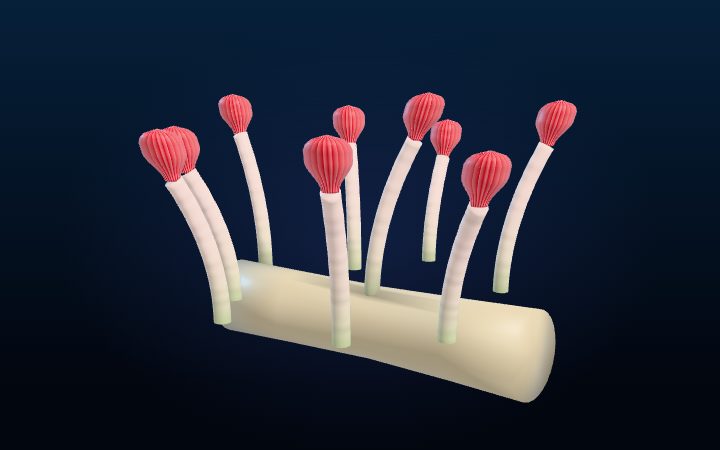
Translucent stalks a few cm long packed across the surface of a whale bone, a red feathery gill at the tip of each, and a green mass of roots reaching into the bone
More about this creature
Where and how deep it lives
O. rubiplumus was first found on a gray whale that sank to about 2,890 m in Monterey Canyon, California, and in 2008 its females also colonized the vertebrae of a juvenile whale MBARI sank at about 1,800 m in Monterey Bay. Between 2004 and 2008 MBARI sank stranded whale carcasses at roughly 385–1,820 m; once sharks and crabs had stripped the flesh, Osedax turned up on the bones at every depth.
Eighteen Osedax species are known from Monterey Bay alone and over thirty worldwide, and within a year of the first discovery the worms were also found on carcasses sunk off Sweden and Japan.
Food and hunting
The root tissue is rich in carbonic anhydrase and secretes acid that dissolves the outer bone, while a mucus sheath around the roots may help with dissolving and protect the trunk from the acid. Symbiotic bacteria of the order Oceanospirillales in the roots make collagen-digesting enzymes, and the worm's own genome lacks some genes for handling bone lipids and carbohydrates, leaving those jobs to the bacteria. The worms have also colonized artificial carcasses of cow, tuna, turtle and turkey bone, so almost any bone on the seafloor can feed them.
Body and adaptations
Females are about 2–7 cm long, with red, feathery plumes that reach into the water and serve as gills. Beneath them a pinkish, muscular trunk withdraws into a transparent tube when disturbed, while green roots, a white ovary and a large egg sac lie buried in the bone. They have no eyes or legs.
Life cycle and behaviour
The first larvae to settle on a bone become females and burrow in; larvae that later land on a female become males. The males never feed, using yolk to make sperm bundles, and a female's harem can grow from a few to hundreds, one of the most male-biased sex ratios known in animals. O. rubiplumus females release hundreds of already-fertilized eggs at once; embryos develop for about three days in mucus attached to the tube before swimming off as larvae to find new bone.
The eggs carry no symbionts, so the bacteria are acquired after settling. MBARI likened this fast-growing, prolific, widely dispersing strategy to dandelions: the worms release eggs or larvae before the carcass is used up.
Humans and conservation
MBARI's remotely operated vehicle Tiburon first photographed the whale in February 2002, and the team studied it for more than a year and a half. In 2004 Rouse, Goffredi and Vrijenhoek described the new genus Osedax (Latin for 'bone devourer') in Science, together with O. rubiplumus and O. frankpressi. DNA showed the worms were relatives of the tubeworms at vents and cold seeps.
A single whale fall can deliver as much organic matter to the seafloor as thousands of years of marine snow, and decomposers such as Osedax help spread that carbon into the food web and surrounding sediments. Borings in a plesiosaur bone from England's Cambridge Greensand, probably about 100 million years old, suggest the group was already eating the bones of large marine reptiles in the Cretaceous.
Sources & further reading
- Osedax — Wikipedia en.wikipedia.org
- Whale carcass yields bone-devouring worms (2004 news release) — MBARI www.mbari.org
- Uncovering the deep-sea world of bone-eating worms — MBARI 2017 Annual Report annualreport.mbari.org