Humpback anglerfish
Scientific name: Melanocetus johnsonii
The Humpback anglerfish is a bioluminescent (light-making) sea creature that lives in open water at depths of about 100–4,500 m, growing to about 18 cm. In Abyss Dive you meet it at 1,500 m, in the Midnight Zone (Bathypelagic).
- Depth range
- about 100–4,500 m
- Max size
- about 18 cm
- Zone in this guide
- Midnight Zone 1,000–4,000 m
- Bioluminescence
- Yes
- Habitat
- Open water (swimming)
- Depth in the 3D dive
- 1,500 m
What is it?
A deep-sea anglerfish that lures prey with a glowing bait at the end of a rod above its head, then swallows it with an enormous mouth. Its stomach stretches so much it can swallow prey bigger than itself. Males are tiny, about 3 cm, and don't attach to females.
Did you know?
The lure's light doesn't come from the anglerfish itself but from symbiotic bacteria living inside the lure.
What it looks like
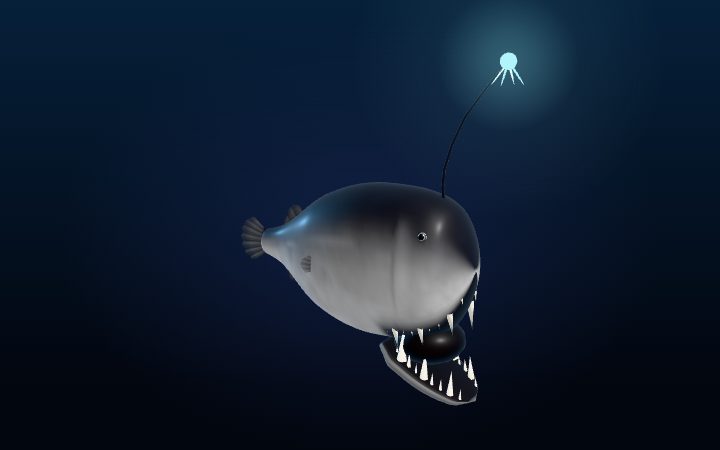
A round, ball-like black body, a huge mouth taking up half the body with inward-curving needle teeth, a rod rising from the forehead tipped with a blue glowing lure, and small fins
More about this creature
Where and how deep it lives
It lives in temperate and tropical waters of every ocean, as well as the South and East China Seas, and has the widest range of any Melanocetus species. A 2014 record from the Ross Sea extended its range into Antarctic waters, and a specimen from British Columbia pushed its known northern limit in the eastern Pacific.
Most specimens come from about 200–1,500 m, and around 65% were caught at 1,000 m or shallower. The larvae live mainly in the top 100 m.
Food and hunting
It is a sit-and-wait ambush predator with a low metabolic rate. Its long, pointed teeth can hold prey larger than itself: one 8.8 g fish had three snipe eels weighing 12.3 g in total in its stomach.
Body and adaptations
Females are soft-bodied and dark brown to black, with a short, globular body and a large, nearly vertical mouth. Small spines dot the skin below the dorsal fin, and the small eyes sit beneath the skin. The lure at the tip of the fishing rod on the snout bears flattened crests at front and back.
The glowing bacterium inside the lure, Enterovibrio escacola, has a genome about 50% smaller than its free-living relatives, yet it can still survive without its host.
Life cycle and behaviour
Males are about 15.5–28 mm long and lack a lure, but have large eyes and nostrils and highly developed senses for tracking a female's scent through still deep water. A male clings to a female only briefly with small teeth, releases sperm and then lets go. So few male specimens exist that much about them remains unknown.
Eggs are released into the water and fertilised outside the body, presumably in floating gelatinous rafts, and the larvae drift as plankton.
Humans and conservation
James Yates Johnson collected the first specimen near Madeira on 24 December 1863, and Albert Günther described the species after him the following year. In 2014 an MBARI remotely operated vehicle filmed a female swimming slowly at about 580 m in Monterey Canyon.
On 5 February 2025 an expedition by the group Condrik Tenerife filmed a living female near the surface in daylight, about 2 km off Tenerife in the Canary Islands, possibly the first such record. It is not fished for food but is caught as bycatch in trawls, and the IUCN Red List rates it Least Concern.
Sources & further reading
- Melanocetus johnsonii — FishBase www.fishbase.se
- Humpback anglerfish — Wikipedia en.wikipedia.org