Spiny skate
Scientific name: Bathyraja spinosissima
The Spiny skate is a sea creature that lives near the seafloor at depths of about 800–2,938 m, growing to about 2 m. In Abyss Dive you meet it at 2,200 m, in the Midnight Zone (Bathypelagic).
- Depth range
- about 800–2,938 m
- Max size
- about 2 m
- Zone in this guide
- Midnight Zone 1,000–4,000 m
- Bioluminescence
- No
- Habitat
- Near the seafloor
- Depth in the 3D dive
- 2,200 m
What is it?
One of the deepest-living skates, recorded down to about 3,000 m. It hunts deep-sea fish near the bottom.
Did you know?
It lays its eggs in tough egg cases about 9 cm long, with horn-like projections, unusually large compared with those of its relatives.
What it looks like
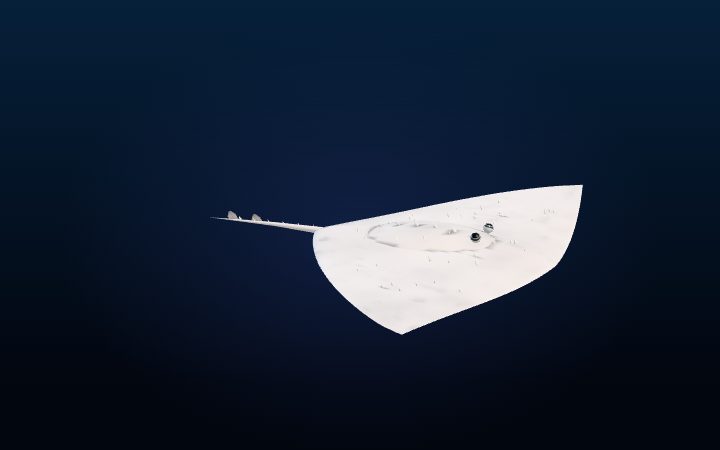
A flat, diamond-shaped, pale whitish-gray body (skate-type, with shorter wings than a ray), covered in fine, dense spines, with a thin, long tail bearing two small dorsal fins
More about this creature
Where and how deep it lives
It ranges along the eastern rim of the North Pacific, from the Bering Sea south to Costa Rica and the Galápagos Islands. Most records come from the continental slope at roughly 800–2,900 m, and it is known to prefer colder water than its close relatives.
In 2015 clusters of its egg cases were found at hydrothermal vents in the Galápagos Marine Reserve. In 2023 a seamount off British Columbia, Canada, long assumed to be extinct, turned out to be still venting warm water, and its summit about 1.5 km down was covered in this skate's eggs.
Food and hunting
It feeds mainly on fishes that live close to the bottom. FishBase estimates its trophic level at about 4.2 from diet data, placing it high in the deep-sea food web.
Body and adaptations
The disc formed by its pectoral fins is slightly wider than long with broadly rounded tips, and tiny denticles give the skin a sandpaper-like feel. Both the upper and lower sides are a uniform pale grey, with darker disc margins. The tail is a little longer than the disc and carries a single central row of 23–29 thorns, and adult males grow extra 'alar' thorns near the disc tips.
Life cycle and behaviour
It lays eggs, and the embryos inside the case live only on yolk. Young hatch at about 25 cm, and females mature at around 98 cm. Development is slow in cold water: the Galápagos team conservatively estimated, from a related species, that incubation could take more than four years.
That team confirmed the species by DNA testing of the cases and, in a 2018 paper, interpreted the vent sites as places where mothers use volcanic heat to speed up development. It was the first animal known to lay its eggs at a hydrothermal vent. The Canadian seamount nursery is estimated at hundreds of thousands to perhaps a million eggs, far larger than the Galápagos one.
Humans and conservation
It has no commercial value but is occasionally caught as bycatch. The IUCN Red List rates it Least Concern (2024 assessment). FishBase, however, rates its resilience as low, with a population doubling time of 4.5–14 years, and the long time its eggs spend on the seafloor is seen as a reason skates are sensitive to overfishing.
The Canadian seamount lies within a proposed marine protected area to be overseen by Indigenous nations, including the Haida and Nuu-chah-nulth, together with the Canadian government.
Sources & further reading
- Bathyraja spinosissima — FishBase www.fishbase.se
- Pacific white skate (Bathyraja spinosissima) — Wikipedia en.wikipedia.org
- This Deep-Sea Creature Lays Its Eggs on Hydrothermal Vents—A First — National Geographic www.nationalgeographic.com
- Ancient Underwater Volcano Off Canada Is Still Active And Teeming With Life — ScienceAlert www.sciencealert.com