Krøyer's deep sea anglerfish
Scientific name: Ceratias holboelli
The Krøyer's deep sea anglerfish is a bioluminescent (light-making) sea creature that lives in open water at depths of about 400–4,400 m, growing to about 1.2 m. In Abyss Dive you meet it at 2,600 m, in the Midnight Zone (Bathypelagic).
- Depth range
- about 400–4,400 m
- Max size
- about 1.2 m
- Zone in this guide
- Midnight Zone 1,000–4,000 m
- Bioluminescence
- Yes
- Habitat
- Open water (swimming)
- Depth in the 3D dive
- 2,600 m
What is it?
A large deep-sea anglerfish with an elongated body and a short fishing rod. Females grow over 1 m long, but the free-swimming males are tiny, only about 1 cm or a bit more.
Did you know?
A small male bites onto the female and clings on; his skin and even his blood vessels fuse with hers, and he stays attached for life.
What it looks like
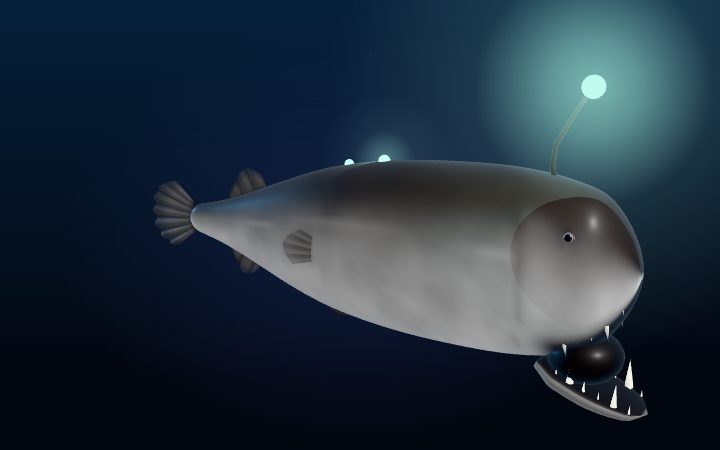
An elongated, egg-shaped dark brown body (female), a large upward-pointing mouth, a light lure at the tip of the short rod on the forehead, small wart-like glowing projections on the back, and a tiny male attached to the belly
More about this creature
Where and how deep it lives
It occurs worldwide from the tropics to subpolar and polar seas, but appears to be absent from the Southern Ocean. In the Atlantic it ranges from about 68°N off Iceland to about 8°S in the central Atlantic. It drifts mostly at about 400–2,000 m, and its overall recorded range differs by source: roughly 150–3,400 m or 400–4,400 m.
Food and hunting
Females lure prey with a fishing rod (illicium) above the snout tipped with a glowing bait (esca). In this family the long base of the rod sticks out of the body and can be pulled back into a groove along the top of the head. The back also carries two or three luminous warts (caruncles) formed from the front dorsal-fin rays.
Body and adaptations
Females are elongated and laterally compressed, with skin densely covered in tiny spines. A single appendage at the tip of the bait bulb sets this species apart within its family, and the rod is about 15–38% of body length. The largest published total length is about 120 cm, the biggest in the family.
Free-swimming males have naked, unpigmented skin, large bowl-shaped eyes and well-developed sense organs for finding a female. They grip her with small teeth on the snout and lower-jaw tips; once attached, they darken and grow spines. Parasitic males can reach about 14–16 cm.
Life cycle and behaviour
Females lay eggs in gelatinous rafts that float upward and are found from the surface to about 200 m. The larvae are planktonic, and in this family males and females already look different as larvae.
Humans and conservation
Danish zoologist Henrik Krøyer described it in 1845, with southern Greenland as the type locality. Ceratias is Greek for 'horn bearer', referring to the lure, and the species name honours Danish naval officer and naturalist Carl Peter Holbøll. The Zoological Museum in Saint Petersburg holds a female with a parasitic male attached to her belly. It has no fisheries value and is rated Least Concern on the IUCN Red List.
Sources & further reading
- Ceratias holboelli — FishBase www.fishbase.se
- Krøyer's deep sea angler fish (Ceratias holboelli) — Wikipedia en.wikipedia.org
- Ceratiidae — Wikipedia en.wikipedia.org