Cuvier's beaked whale
Scientific name: Ziphius cavirostris
The Cuvier's beaked whale is a sea creature that lives in open water at depths of about 0–2,992 m, growing to about 7 m. In Abyss Dive you meet it at 2,950 m, in the Midnight Zone (Bathypelagic).
- Depth range
- about 0–2,992 m
- Max size
- about 7 m
- Zone in this guide
- Midnight Zone 1,000–4,000 m
- Bioluminescence
- No
- Habitat
- Open water (swimming)
- Depth in the 3D dive
- 2,950 m
What is it?
A medium-sized whale with a short beak and a rounded forehead that specializes in hunting squid in deep water. It rarely shows itself at the surface, so much of its ecology is still unknown.
Did you know?
It holds both mammal diving records: about 2,992 m in 2014, and a single breath-hold dive of about 3 hours 42 minutes (222 minutes).
What it looks like
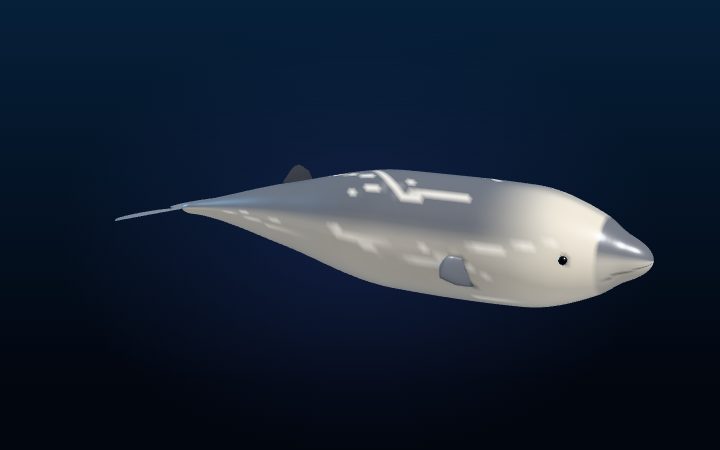
A stout, spindle-shaped gray-brown body (with scar-like white scratches), a short beak and rounded forehead, a small dorsal fin set far back on the body, and small pectoral fins
More about this creature
Where and how deep it lives
It lives in tropical to temperate waters of the Atlantic, Pacific and Indian Oceans and has the widest range of any beaked whale. It also occurs in semi-enclosed seas such as the Mediterranean and Gulf of Mexico but is rare in shallow seas like the North and Baltic Seas, keeping mostly to offshore water deeper than 1,000 m around continental slopes, canyons and seamounts. Much of what is known about its range comes from strandings; its seasonal movements are unknown, and genetic studies suggest animals mostly stay within their home ocean basin.
Food and hunting
Squid make up most of its diet. In a North Pacific stomach-content study, cephalopods accounted for 98.0% of prey by number and 87.7% by mass, with at least 37 squid species identified. It also takes deep-sea fish and some crustaceans.
It finds prey in the dark by echolocation, using the melon in its forehead, and sucks prey in by expanding throat grooves. Foraging dives typically go deeper than 800 m and last 30–90 minutes, followed by several shorter, shallower dives. Its brief surface intervals may help it avoid killer whales and large sharks.
Body and adaptations
Adults are roughly 4.5–7 m long and weigh about 1.8–3 tonnes, with little size difference between the sexes. Only adult males have teeth that erupt: two cone-shaped tusks at the tip of the lower jaw, thought to be used in fights. Males are dark grey with a pale head; females range from dark grey to reddish-brown. Scratches and oval scars, likely from male fights and from cookiecutter sharks and lampreys, build up with age and are used to identify individuals.
Life cycle and behaviour
Groups usually number two to seven, with larger groups reported occasionally, and lone animals are most often males. It rarely breaches, and its low blow, about 1 m high, makes it hard to spot.
It matures at around 7–11 years. Breeding and calving happen year-round but peak in spring; gestation lasts about a year, and females have a single calf every two to three years. Newborns are about 2–3 m long and 250–300 kg, and the species can live to about 60.
Humans and conservation
Georges Cuvier described it in 1823 from a skull found on France's Mediterranean coast, at first thinking it belonged to an extinct animal. In 1850 Paul Gervais matched the skull to a stranded whale. The species name cavirostris means 'hollow beak', after a deep hollow in the skull.
Several mass strandings have been linked to naval mid-frequency sonar. In the Canary Islands, strandings followed Spanish Navy exercises and stopped once sonar exercises were banned, and stranded whales often showed signs of decompression sickness and gas embolism. Entanglement in fishing gear and small-scale Japanese whaling are other threats; the IUCN rated it Least Concern in its 2020 assessment.
Sources & further reading
- Cuvier's beaked whale — Wikipedia en.wikipedia.org
- Cuvier's Beaked Whale — NOAA Fisheries www.fisheries.noaa.gov