Tripod fish
Scientific name: Bathypterois grallator
The Tripod fish is a sea creature that lives near the seafloor at depths of about 880–4,720 m, growing to about 43 cm. In Abyss Dive you meet it at 3,550 m, in the Midnight Zone (Bathypelagic).
- Depth range
- about 880–4,720 m
- Max size
- about 43 cm
- Zone in this guide
- Midnight Zone 1,000–4,000 m
- Bioluminescence
- No
- Habitat
- Near the seafloor
- Depth in the 3D dive
- 3,550 m
What is it?
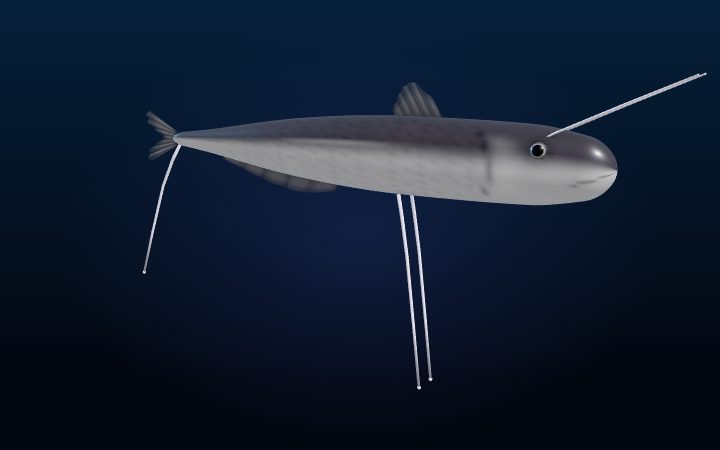
It stands on the seafloor on three long, thin fin rays like legs, facing into the current. It detects small crustaceans drifting past with the fins at its front, then snatches them.
Did you know?
Each individual has both male and female reproductive organs (a hermaphrodite), so it can breed even if it never meets a mate in the vast deep.
What it looks like
A slender gray body, with two pelvic-fin rays and the lower tail-fin ray stretching as long as the body to form three legs, and pectoral-fin rays reaching out over the head like antennae
More about this creature
Where and how deep it lives
It lives in tropical to warm-temperate waters of the Atlantic, Indian and western central Pacific Oceans, roughly between 40°N and 40°S. In the western Atlantic it ranges from the US east coast to the Gulf of Mexico and the Caribbean, and in Australia it is known off North West Cape and from eastern waters. It occupies the lower continental slope, continental rise, ocean ridges and abyssal plains at about 880–4,720 m, in water of about 2.7–13.5 °C.
Food and hunting
It eats mostly small animals drifting in the water, and its menu shifts with size. Fish under 200 mm take copepods, amphipods and crustacean larvae, larger ones add mysid shrimps, and above 240 mm fishes and decapods make up most of the diet by weight, with fish alone about 78.7%.
It is mainly a sit-and-wait predator, though larger individuals also ambush prey. Its eyesight is poor, with no special adaptations for low light, so it relies on touch and on sensing water movement to find food.
Body and adaptations
The two pelvic fins and the lower rays of the tail fin are stretched into stilts up to about 1 m long, around three times body length, and pads at their tips let the fish perch above soft sediment. The rays are flexible while swimming and stiff while standing, possibly because fluid is pumped into them. The fish is slightly heavier than water, which keeps it from drifting while it waits for prey. It is the largest species in its genus, reaching about 43 cm total length.
Life cycle and behaviour
It is a weak swimmer that alternates between swimming and resting on the bottom. When landing it touches down on its pelvic fins first, then lowers the tail fin to adjust its heading, and recent ROV footage suggests it shifts position in response to bottom currents. Each fish has an ovotestis with both male and female tissue; it spawns eggs and sperm into the water and can fertilize itself if no partner is around.
Humans and conservation
Goode and Bean described it in 1886. Grallator is Latin for 'one who walks on stilts', after the way it props itself up on its fin rays. It is one of the few Bathypterois species that have been watched and photographed directly from submersibles.
It is listed as Least Concern by the IUCN. FishBase, however, rates its resilience as very low, with a population doubling time of more than 14 years, and while deep-sea mining, drilling and plastic waste affect its habitat, the scale of the risk is hard to judge.
Sources & further reading
- Bathypterois grallator — FishBase www.fishbase.se
- Bathypterois grallator — Wikipedia en.wikipedia.org
- Tripod Spiderfish, Bathypterois grallator — Fishes of Australia fishesofaustralia.net.au