Pompeii worm
Scientific name: Alvinella pompejana
The Pompeii worm is a sea creature that lives near the seafloor at depths of about 2,300–2,700 m, growing to about 13 cm. In Abyss Dive you meet it at 2,500 m, in the Midnight Zone (Bathypelagic).
- Depth range
- about 2,300–2,700 m
- Max size
- about 13 cm
- Zone in this guide
- Midnight Zone 1,000–4,000 m
- Bioluminescence
- No
- Habitat
- Near the seafloor
- Depth in the 3D dive
- 2,500 m
What is it?
A marine bristle worm that builds its tube on the wall of a hydrothermal-vent chimney at about 2,500 m on the East Pacific Rise. About 10 cm long, it's one of the animals that endure the hottest environments on Earth.
Did you know?
The tail end inside the tube sits in water around 50°C, while the head poking out is in water around 22°C. On its back it wears a fleece of bacteria about 1 cm thick.
What it looks like
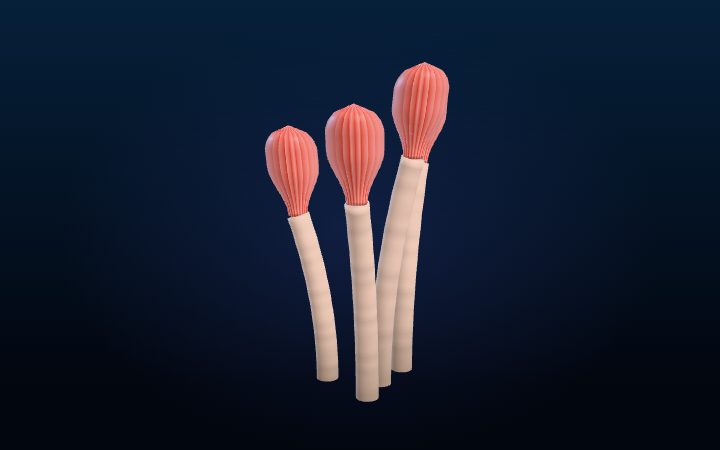
A pinkish-gray body about 10 cm long, half out of a paper-like tube set into the chimney wall, red feathery gills on the head, and a mass of bacteria covering the back like white fur
More about this creature
Where and how deep it lives
It is found only on the East Pacific Rise, between about 21°N and 32°S. It was first identified off the Galápagos Islands, and in 1997 it was also found on vents near Costa Rica. It lives exclusively on the surfaces of actively venting, high-temperature chimneys, alongside other bristle worms, amphipods and crabs.
Food and hunting
It extends and retracts ciliated feeding tentacles on its head to gather bacteria or absorb organic matter from the vent fluid. The bacteria on its back are chemosynthetic and also feed on mucus secreted by glands along the worm's back. Recent work suggests these bacteria may contribute to the worm's own nutrition as well.
Body and adaptations
The pale grey body is less than 1 cm across, with red, feathery gills on the head coloured by hemoglobin. These gills have the highest specific surface area of any polychaete. Its blood is kept relatively cool, about 20–30 °C, and slightly acidic (pH 6.6–6.9), which helps it load oxygen and release it to tissues. Heat resistance is credited to proline-rich, highly stable collagen, a plywood-like tube of sulfur-rich glycoprotein, and its coat of bacteria.
Early reports claimed tolerance up to 80 °C, but those readings may have been skewed by puncturing the worms. In 2013 a French team collected live worms without decompressing them and tested them in a pressurized aquarium: two hours at 50–55 °C caused tissue damage and death. They put the upper limit below 55 °C and the optimum above 42 °C, which still ranks it among the most heat-tolerant animals.
Life cycle and behaviour
Sexes are separate, and only males have a pair of tentacles near the mouth. Females store sperm in spermathecae, and the eggs develop on their own yolk. In experiments, embryos developed only in water much colder than that around the adults: those placed inside an adult colony had just 10% survival by day five, while those placed at a chimney base or among giant tubeworms developed well. One hypothesis holds that larvae may travel through the subsurface to reach new vents.
Humans and conservation
Daniel Desbruyères and Lucien Laubier described it in 1980. Its family (Alvinellidae) and genus are named after the submersible Alvin, and the species name refers to Pompeii, the Roman city buried by Vesuvius in AD 79. Some researchers suggest its bacteria could be useful to the biochemical, pharmaceutical, textile, paper and detergent industries.