Colossal squid
Scientific name: Mesonychoteuthis hamiltoni
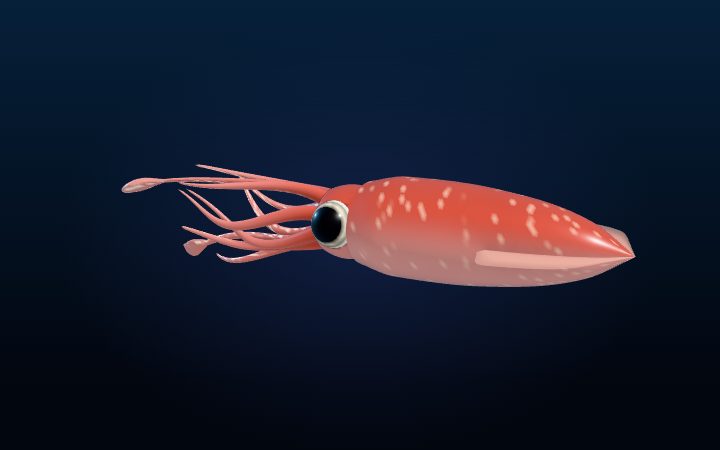
The Colossal squid is a sea creature that lives in open water at depths of about 200–4,000 m, growing to about 10 m. In Abyss Dive you meet it at 1,700 m, in the Midnight Zone (Bathypelagic).
- Depth range
- about 200–4,000 m
- Max size
- about 10 m
- Zone in this guide
- Midnight Zone 1,000–4,000 m
- Bioluminescence
- No
- Habitat
- Open water (swimming)
- Depth in the 3D dive
- 1,700 m
What is it?
The heaviest squid, living in the Southern Ocean. Adults live mostly in the mesopelagic to bathypelagic zones. Rotating hooks on its arms and tentacles mean that anything it grabs doesn't get away.
Did you know?
A specimen of about 495 kg was caught, making it the heaviest invertebrate on record. A live one was first filmed only in 2025 (a juvenile about 30 cm long).
What it looks like
A thick, heavy red mantle with broad heart-shaped terminal fins, enormous eyes, and rotating hooks instead of suckers on the arms and tentacle clubs
More about this creature
Where and how deep it lives
It lives right around Antarctica in the Southern Ocean, reaching north to southern South America, southern South Africa and the southern tip of New Zealand. It is often encountered near the Ross Sea and the Cooperation Sea, and the waters from the Weddell Sea to the western Kerguelen Islands are considered a hotspot.
Depth changes with age: young squid live at about 0–500 m, adolescents at about 500–2,000 m, and adults go deeper still. Adult females have been found in comparatively shallow water, hinting that they may spawn at shallower depths.
Food and hunting
It eats mainly small fishes such as lanternfishes and deep-sea smelts but also attacks bigger fish: of 8,000 Antarctic toothfish landed by trawlers in 2011–2014, 71 bore signs of colossal squid attacks. Trophic analyses suggest it also takes Patagonian toothfish and smaller squid, and squid remains in the stomach of a female from Prydz Bay raised the possibility of cannibalism.
Its metabolism is so slow that a 500 kg adult may need only about 30 g of food a day. It is therefore thought to be a slow ambush predator that spots prey with its huge eyes rather than chasing it down.
Body and adaptations
Its eyes are about 27–30 cm across, and those of the largest specimen were probably about 40 cm in life, the largest of any animal on record. They may let it detect a predator's movement beyond about 120 m, the reported limit of a sperm whale's sonar, and since it is nearly deaf to high frequencies it relies mainly on sight. Beside each eye is a long, rectangular light organ lit by symbiotic bacteria.
It is the only glass squid (Cranchiidae) with hooks on its arms and tentacles. As the juvenile filmed in 2025 showed, each of the eight arms carries a pair of fixed hooks midway along, and the two tentacles end in fully rotating hooks. The largest confirmed total length is about 4.2 m; estimates of 10 m or more include the stretched tentacles of dead specimens.
Life cycle and behaviour
Females are thought to be the larger sex. One female's ovary may have held more than 4.2 million eggs, averaging about 2,175 per gram of ovary. Spawning is thought to happen near the surface in summer, at water temperatures of about -0.9 to 0 °C.
Sperm whales are its main predator: about 14% of the squid beaks found in their stomachs belong to this species, which is estimated to represent about 77% of the squid biomass they eat. Beaked whales, pilot whales, killer whales, southern sleeper sharks, southern elephant seals, toothfishes and wandering albatrosses also eat it.
Humans and conservation
Two arm crowns were found in a sperm whale's stomach in the winter of 1924–25, and in 1925 Robson described the species, naming it after E. Hamilton, who made the find. A Soviet trawler caught an immature female more than 4 m long in the Ross Sea in 1981, and in 2005 the first complete animal was hauled up alive from 1,625 m off South Georgia.
The female caught alive by a New Zealand fishing boat in the Ross Sea in February 2007 had a 2.5 m mantle and a total length of 4.2 m, and has been on display at Te Papa, the Museum of New Zealand, since December 2008. The 2025 footage was shot during an Ocean Census expedition aboard the Schmidt Ocean Institute vessel Falkor (too), and experts including Kat Bolstad of Auckland University of Technology confirmed the species from its arm-hook pattern. No fishery targets it, it is caught only when it attacks fish on longlines, and the IUCN Red List rates it Least Concern (2014 assessment).
Sources & further reading
- Colossal squid — Wikipedia en.wikipedia.org
- First ever video shows colossal squid in natural habitat — National Geographic www.nationalgeographic.com