Green bomber worm
Scientific name: Swima bombiviridis
The Green bomber worm is a bioluminescent (light-making) sea creature that lives in open water at depths of about 1,800–3,700 m, growing to about 3 cm. In Abyss Dive you meet it at 3,000 m, in the Midnight Zone (Bathypelagic).
- Depth range
- about 1,800–3,700 m
- Max size
- about 3 cm
- Zone in this guide
- Midnight Zone 1,000–4,000 m
- Bioluminescence
- Yes
- Habitat
- Open water (swimming)
- Depth in the 3D dive
- 3,000 m
What is it?
A bristle worm of about 3 cm that swims in the water just above the seafloor. Researchers at the Scripps Institution of Oceanography in the US reported it as a new species in 2009.
Did you know?
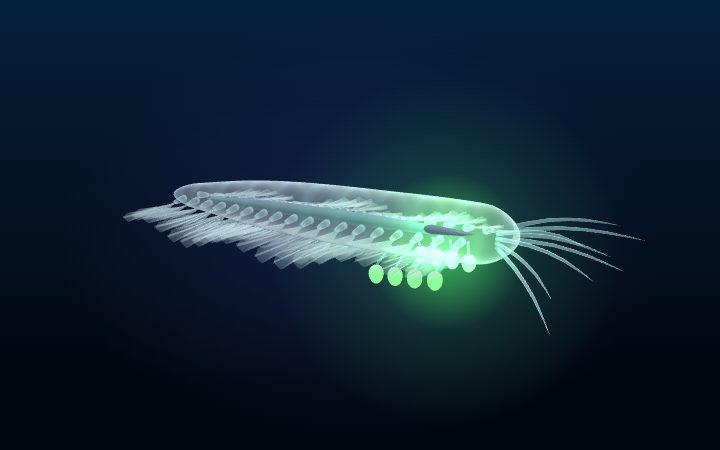
It has eight sacs of glowing fluid behind its head, and when threatened it detaches one and throws it. While the dropped 'bomb' glows green for a few seconds, the worm makes its escape.
What it looks like
A translucent body about 3 cm long with rows of oar-like bristle tufts on either side, several long tentacles at the front of the head, and eight green, bead-like sacs behind the head
More about this creature
Where and how deep it lives
MBARI records these worms in the northeastern Pacific at about 2,700–3,600 m, swimming a few metres above the seafloor. Observations so far span roughly 1–450 m above the bottom, and the worm is thought to spend its whole life in open water without settling. The first specimens came from off Monterey Bay, California. It is often seen in groups of hundreds, so it is not rare, just hard to reach.
Body and adaptations
Apart from the gut region the body is nearly transparent and wrapped in a gelatinous sheath. Each paddle-like side appendage (parapodium) bears a fan of about 30 chitin bristles, which the worm uses as oars while undulating from side to side. Adults can exceed 30 mm long and 5 mm wide, large for its family, Acrocirridae.
Each 'bomb' is about 1 mm long and made of fluid-filled sacs. Related bottom-dwelling worms have easily shed gills in exactly the same position, which is why the bombs are thought to have evolved from gills. A released bomb glows intensely for several seconds before slowly fading, and lost bombs are regrown.
Life cycle and behaviour
Touching the body makes the worm release only a few bombs at a time. Because juveniles have bombs too, they are unlikely to be reproductive; the leading idea is a decoy defence like a squid's glowing ink, though this is unconfirmed. Submersible lights prevented scientists from seeing bombs released in the wild, so the behaviour has only been watched aboard ship after capture. Its diet is still unknown.
Humans and conservation
In August 2009 Karen Osborn, who studied the worms at MBARI before becoming a postdoctoral fellow at Scripps Institution of Oceanography, and four colleagues described seven new swimming worms in Science, the first being the green bomber. The seven species were 18–93 mm long and came from about 1,800–3,700 m, and five of them carried luminous structures. They were found with remotely operated vehicles and submersibles, mainly off California.
Swima refers to its swimming, and the species name joins Latin bombus ('buzzing', the root of 'bomb') with viridis ('green'). A second species, the shining bomber worm S. fulgida, was described in 2011. The researchers stressed that the 1,000–4,000 m depth band is Earth's largest habitat and among its least explored.
Sources & further reading
- Bomber worm — MBARI www.mbari.org
- Swima bombiviridis — Wikipedia en.wikipedia.org
- Scientists Discover Bioluminescent 'Green Bombers' from the Deep Sea — Scripps Institution of Oceanography scripps.ucsd.edu
- New species of deep-sea worms release glowing bombs (2009) — MBARI www.mbari.org