Deepstaria jellyfish
Scientific name: Deepstaria enigmatica
The Deepstaria jellyfish is a sea creature that lives in open water at depths of about 600–1,750 m, growing to about 60 cm. In Abyss Dive you meet it at 1,100 m, in the Midnight Zone (Bathypelagic).
- Depth range
- about 600–1,750 m
- Max size
- about 60 cm
- Zone in this guide
- Midnight Zone 1,000–4,000 m
- Bioluminescence
- No
- Habitat
- Open water (swimming)
- Depth in the 3D dive
- 1,100 m
What is it?
A jellyfish with no tentacles, just a thin, broad bell. It spreads the bell wide, then closes it to wrap up prey and trap it. It's seen mostly in the waters around Antarctica, but has also been observed near Britain and in the Gulf of Mexico.
Did you know?
It's named for the submersible Deepstar 4000, which collected the first specimen. The transparent bell looks like a plastic bag drifting in the water.
What it looks like
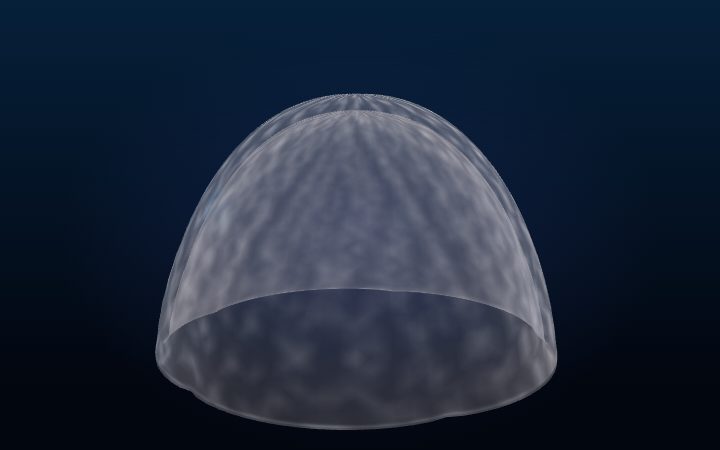
A very thin, transparent, cloth-like bell about 60 cm across (no tentacles), with a net-like geometric pattern of canals across the surface and a fabric-like, fluttering edge
More about this creature
Where and how deep it lives
Jellies of the genus Deepstaria are found at roughly 600–1,750 m. The first specimen was collected in 1966 at about 723 m in the San Diego Trough off southern California; others have since come from midwater trawls in the Gulf of Mexico and the central North Atlantic and from submersible dives off southern California.
In November 2017 the remotely operated vehicle Hercules, deployed from the exploration vessel Nautilus, followed a live animal for nearly ten minutes at about 974 m off San Benedicto Island, Mexico. It lives alone rather than in groups.
Food and hunting
With no tentacles, the bell itself is the trap. In the 2017 footage the bell margin closed within seconds, and a contraction wave starting at the bottom of the bell climbed at about 1.5 cm per second, forming a bulging central pouch. The bell stayed pursed for about a minute before reopening.
Clusters of stinging cells on the underside of the bell support the idea that it is an ambush predator that waits and then engulfs prey. Captured food is digested through the net of gastrovascular canals spread across the bell, which also carry nutrients and oxygen around the body. What it mainly eats is still unknown.
Body and adaptations
Laser scale markers put the 2017 animal at about 68 cm long and 56 cm across. A trawled Gulf of Mexico specimen was more than 70 cm wide, with jelly about 18 mm thick at the centre of the disc. A geometric mesh of canals shows through the transparent bell.
It makes no light of its own and moves by peristalsis, rippling its whole body. During the 2017 observation a glowing bristle worm (Tomopteris) swam alongside it.
Life cycle and behaviour
On a 1967 dive a bright red isopod about 8 cm long was seen moving actively inside one of these jellies. A 1969 paper placed it in the genus Anuropus and suggested the relationship might be parasitic, while others think the isopod simply rides along for food and protection; the true nature of the partnership is still unclear.
When it dies, the body sinks and feeds other animals. In 2017, at about 899 m east of Socorro Island, at the lower edge of an oxygen minimum zone, a Deepstaria carcass was filmed with lithodid crabs (Paralomis) and shrimp crowded on it at more than 80 per square metre, direct evidence that a single carcass can act as a 'jelly fall' feeding the seafloor. The video could not show whether it was this species or its relative D. reticulum.
Humans and conservation
Russell described the genus and species in 1967 in the Journal of the Marine Biological Association of the United Kingdom. The submersible that collected the first specimen, Deepstar 4000, was built in 1965 and retired in 1972. A second species, D. reticulum, was described in 1988.
Because the jelly is so fragile that nets destroy it, scientists long relied on damaged specimens, photographs and glimpses through submersible windows. The 2017 team used a low-light camera to disturb the animal as little as possible, and published the results in American Museum Novitates in 2018.
Sources & further reading
- Deepstaria enigmatica — Wikipedia en.wikipedia.org
- Deepstaria — Wikipedia en.wikipedia.org
- In situ Observations of the Meso-Bathypelagic Scyphozoan, Deepstaria enigmatica — American Museum Novitates (2018) bioone.org
- Rare jellyfish filmed off Mexico — National Geographic www.nationalgeographic.com