Stoplight loosejaw
Scientific name: Malacosteus niger
The Stoplight loosejaw is a bioluminescent (light-making) sea creature that lives in open water at depths of about 500–3,890 m, growing to about 26 cm. In Abyss Dive you meet it at 1,320 m, in the Midnight Zone (Bathypelagic).
- Depth range
- about 500–3,890 m
- Max size
- about 26 cm
- Zone in this guide
- Midnight Zone 1,000–4,000 m
- Bioluminescence
- Yes
- Habitat
- Open water (swimming)
- Depth in the 3D dive
- 1,320 m
What is it?
A deep-sea fish with no skin on the floor of its lower jaw, leaving only a bony frame, which it thrusts out to snatch prey. It almost never rises above 500 m.
Did you know?
A rare fish that makes red light in the sea. Because most deep-sea animals can't see red, it can light up its prey without being noticed. To see red itself, it uses chlorophyll derivatives taken from its prey (copepods) in its eyes.
What it looks like
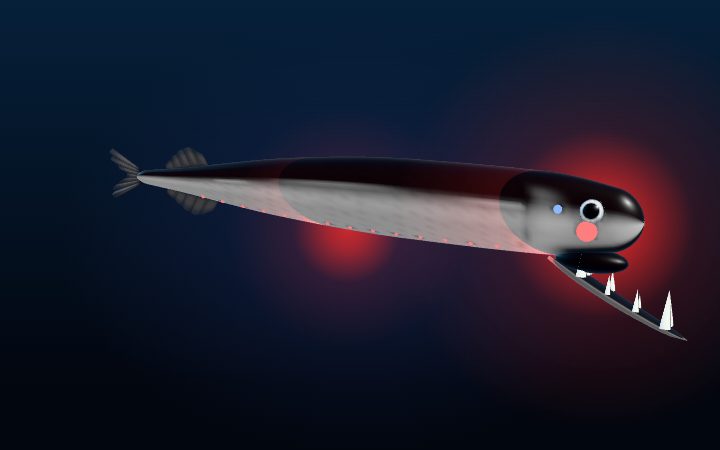
A slender black body, a skinless, bony lower jaw about a quarter of the body length (with long fangs), a large red light organ below the eye, and a small blue one behind it
More about this creature
Where and how deep it lives
It lives in all oceans from about 66°N to 33°S, but is unknown from the Mediterranean and absent from Arctic and sub-Antarctic waters. In Australia it has been recorded northwest of Cape Leveque in Western Australia, in the Coral Sea off Queensland, around the Cocos (Keeling) and Christmas Islands, and on the Norfolk Ridge in the Tasman Sea. A separate southern species, M. australis, described in 2007, lives at about 25–45°S.
Recorded depth ranges vary by source, from about 500–3,500 m to 500–3,886 m. It belongs to the only group of dragonfishes (Stomiidae) known not to make daily vertical migrations.
Food and hunting
Despite a mouth built for big prey, its stomach contents are mostly large calanoid copepods, with fewer krill, shrimps and fishes. Copepods are roughly a thousand times more abundant than fishes at its depths, which has led to the idea that it 'snacks' on copepods between rare large meals.
How a jaw with no floor catches such small prey is still unclear. Red light fades quickly in seawater, so its searchlight reaches less far than the blue light used by other species.
Body and adaptations
The lower jaw is about a quarter of the body length, giving one of the widest gapes of any fish for its size. There is no skin between the two halves of the lower jaw, which is attached only by its hinge and a single muscle, and a flexible joint between the back of the skull and the first vertebra lets it throw its head back to open even wider. Large fang-like teeth at the front are followed by many small barbed ones.
Its gills are exposed, so it can keep breathing while slowly swallowing large prey. A teardrop-shaped organ under each eye emits red light peaking at about 708 nm, working like a searchlight; another organ behind the eye is larger in males, and rows of blue light organs run along the flanks and belly. Its skin is thin, black and scaleless, and its large eyes face forward.
Humans and conservation
Ayres described it in 1848 from a specimen caught southeast of Nova Scotia, Canada (42°N, 50°W). The genus name means 'soft bone' in Greek, and it is also called the rat-trap fish. In 2007 Kenaley examined more than 450 specimens and split the genus into two species. It has no fishery value, is harmless to people and is rated Least Concern on the IUCN Red List.
Sources & further reading
- Stoplight loosejaw — Wikipedia en.wikipedia.org
- Malacosteus niger — FishBase www.fishbase.se
- Stoplight Loosejaw, Malacosteus niger — Fishes of Australia fishesofaustralia.net.au